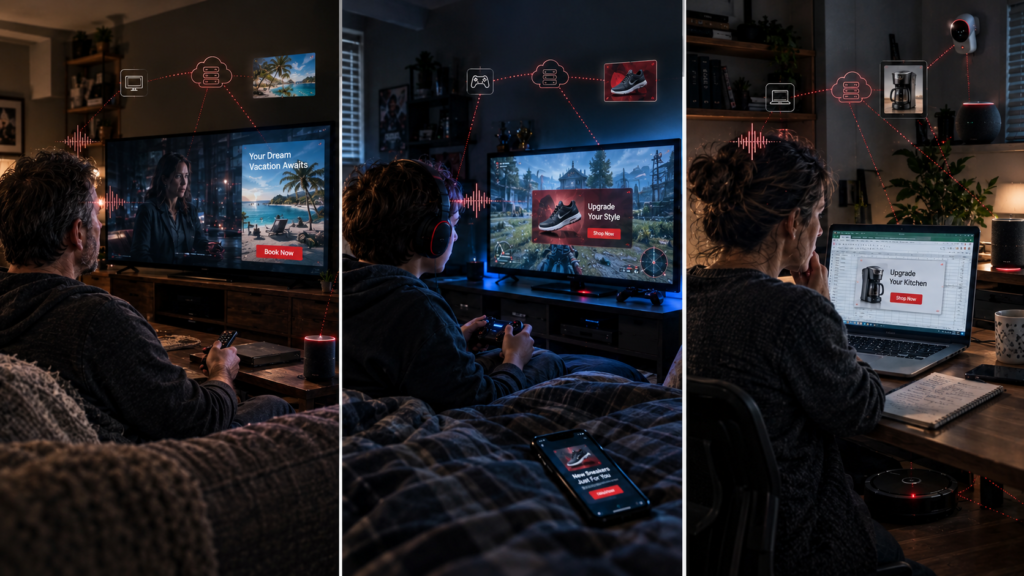
In this article: A Microsoft patent, recent allegations involving LG smart TVs, the history of smart-TV tracking, and the growing number of devices collecting information about what we watch, where we go, what we say, and what we do. More importantly, I want to ask a simple question: When did buying a product become permission for the company that made it to monitor you?
I want to talk about something that has been bothering me.
We buy a television.
We buy a phone.
We buy a car.
We buy a smart speaker.
We buy a security camera.
We buy a robot vacuum.
And increasingly…
We’re buying devices that can see us, hear us, track us, monitor us, and collect information about what we’re doing.
And we’re told it’s okay because somewhere inside a Terms of Service agreement, there’s a paragraph explaining what the company can collect.
Maybe you clicked “I Agree.”
Maybe you didn’t even read it.
Maybe you couldn’t use the product without agreeing to it.
But somehow…
That is supposed to count as consent.
I don’t think it should.
And some of the recent reporting surrounding LG smart televisions has made me ask an even bigger question.
When you buy a television, who actually owns it?
Because one LG executive has used some very interesting language to describe the company’s relationship with the television sitting in your home.
The Microsoft Patent
Let’s start with Microsoft.
There is a Microsoft patent titled “System and method for monitoring user actions with respect to a resource presented by a web browser.”
The U.S. patent was eventually granted as US12395510B2 in August 2025.
The patent describes a system involving a proxy server that can monitor actions a user takes involving resources presented through a web browser or file viewer.
It describes receiving information about user actions and potentially blocking actions such as copying, editing, saving, or printing.
Now, I want to be very clear about something.
A patent does not prove that Microsoft is currently deploying the exact system described in the patent against consumers.
A company can patent technology that it never ultimately uses.
But that’s not really what bothers me.
What bothers me is the direction.
The technology exists.
The patent exists.
The ability to monitor what users are doing with digital content is being developed and protected.
I would like to add that Microsoft isn’t known for doing the right thing lately, look at Windows 11 and the way they treat employees.
And we’re living in a world where more and more of the things we use every day are connected to the internet.
Which brings me to LG.
Then There Is LG
Recent investigations by Gamers Nexus, Level1Techs, and independent researchers raised serious questions about what LG smart televisions can monitor and collect.
Researchers reported that LG televisions can scan local networks and identify other devices connected to the same network.
They also raised concerns about LG’s Automatic Content Recognition, or ACR, technology.
ACR can identify content being displayed on a television and can be used for advertising and audience measurement.
And then there’s the part that really caught my attention.
LG has talked openly about the value of having access to the television itself.
In a presentation discussing LG’s connected-TV advertising business, LG Ad Solutions president Serge Matta said:
“In the fact that we have the glass, we own the glass, we own the TV.”
— Serge Matta, President, LG Ad Solutions
That statement is important because “the glass” is industry terminology referring to the television screen.
And when I hear a company executive say “we own the glass, we own the TV,” I have to ask:
What exactly does that mean?
I bought the television.
I paid for it.
It’s sitting in my house.
So what does LG mean when it says it owns the TV?
Another LG Ad Solutions executive, Justin Fromm, was quoted describing the company’s access to first-party ACR data:
“Because we own the glass … and we have first-party ACR data … we understand everything that hits the screen.”
Another LG executive, Julian Zilberbrand, described the company’s knowledge of an LG household this way:
“At LG, we know who is in the LG household. We know which devices are there, we know what you are exposed to on TV and we know how to extend that reach into mobile.”
Those statements were made in the context of LG’s advertising business.
They aren’t, by themselves, proof that LG is secretly spying on people.
And LG strongly disputes some of the more serious allegations that have recently been made.
Ars Technica — LG TV shown capable of tracking user activity even when offline
Tom’s Hardware — LG strongly denies TV security claims
LG says ACR is optional and says its televisions do not continuously record ambient conversations.
So we need to distinguish between what researchers have alleged, what LG says its products do, and what has actually been independently established.
But even putting the most controversial allegations aside…
The business model itself deserves scrutiny.
Because I don’t think consumers generally understand that the television they bought can become a data-collection device sitting in the middle of their living room.
And I certainly don’t think most people think they’re buying a television while simultaneously giving the manufacturer an ongoing relationship with everything that appears on that screen.
This isn’t being put into plain language either in the user agreements. This is an unethical business practice that los of companies are allowed to engage in.
This Isn’t the First Time a Smart TV Has Raised These Questions
LG isn’t the first television company to face questions about data collection.
Smart TVs have been collecting viewing information for years.
And we’ve already seen cases where regulators became involved.
This Isn’t the First Time a Smart TV Has Raised These Questions
LG isn’t the first television company to face questions about data collection.
Smart TVs have been collecting viewing information for years.
And we’ve already seen cases where regulators became involved.
Vizio and 11 Million Televisions
In 2017, the Federal Trade Commission announced that Vizio had agreed to pay $2.2 million to settle charges that it collected viewing histories from approximately 11 million televisions without consumers’ knowledge or consent.
FTC — Vizio to Pay $2.2 Million
According to the FTC, Vizio televisions collected second-by-second information about what people were watching.
That could include programming coming from cable, broadband, set-top boxes, DVDs, over-the-air broadcasts, and streaming devices.
The information could then be combined with demographic information such as age, sex, income, marital status, household size, education, home ownership, and home value.
The FTC said Vizio then sold the information to third parties for advertising purposes.
This wasn’t some hypothetical privacy concern.
It resulted in a federal enforcement action.
And it raises an obvious question.
If a person buys a television, should they have to specifically opt out of being monitored?
Or should the company have to specifically ask permission before collecting the information in the first place?
I know where I stand.
I think the second option makes far more sense.
And Now Vizio Is Owned by Walmart
There’s another development with Vizio that I think makes this issue even more interesting.
Walmart completed its acquisition of Vizio in December 2024.
And Walmart didn’t just acquire the television hardware.
It acquired Vizio and its SmartCast operating system, giving Walmart another way to connect television viewing with its advertising business.
Then, in mid-March 2026, Walmart changed the setup process for new Vizio televisions.
According to Walmart’s own customer-support documentation:
“Starting mid-March 2026, you must sign in with or create a Walmart account when setting up a new VIZIO or onn powered by VIZIO TV. A Walmart account is required to use Smart TV features and streaming apps.”
You can still use basic functions such as HDMI and an antenna without signing in.
But if you want to use the television’s Smart TV features, streaming apps, software updates, and downloads, Walmart says you need a Walmart account.
And Vizio’s own current terms say essentially the same thing:
“Since VIZIO is a Walmart brand, a Walmart account is required to use the Smart TV features on some newer VIZIO OS products.”
Now, I want to be careful here.
I’m not saying that creating a Walmart account automatically means Walmart gets access to everything you watch.
Vizio’s current privacy policy specifically says consumers have a choice about whether to allow Walmart access to certain VIZIO OS Data, including Viewing Data, Activity Data, Mobile App Data, and Mobile Streaming Data.
Is it really a choice when the opt out is hidden in the menus and you are automatically opted in?
But the relationship has still changed.
The television manufacturer is now owned by Walmart.
The television’s smart features are being tied to a Walmart account.
And Walmart itself has described the purpose of the unified account system as:
“connecting streaming engagement directly with retail interaction.”
Think about that.
You buy a television.
You bring it home.
You turn it on.
And to use the smart features you paid for, you’re now being asked to create an account with the company that owns the television manufacturer.
That doesn’t automatically prove wrongdoing.
But it does demonstrate how the television is becoming part of something much larger than a device sitting in your living room.
Just remember that these are the same people that are trying to introduce dynamic pricing and have work force that is poorly compensated, strong armed goods manufacturers to lower their prices to the point that they were put out of business or forced to move their manufacturing overseas.
It’s becoming part of a retail, advertising, and connected-TV ecosystem.
And that’s exactly why I think consumers deserve to know what they’re actually agreeing to when they buy one.
There’s another important detail in Vizio’s current privacy documentation.
Vizio says that if you sign into a Vizio OS product with a Walmart account, Vizio will automatically provide Walmart with information reasonably necessary to provide Smart TV functionality, such as contact details, payment information, subscription information, and account authentication and security information.
Vizio also says that consumers can choose whether to allow Walmart access to additional Vizio OS data, including Viewing Data and Activity Data.
And Vizio’s Viewing Data documentation explains just how extensive that information can become when the feature is enabled.
Its ACR technology can recognize audio and video programming, advertisements, gaming content, devices connected to the television, and third-party apps in real time.
Vizio says Viewing Data can include information such as volume, channel information, picture controls, inputs, whether the TV is on or off, and whether content was viewed live or later.
Vizio says Viewing Data can be used for audience measurement and tailored advertising, including advertising across other Vizio and third-party platforms or devices.
It also says that data can be associated with information connected to a Vizio or Walmart account.
Again…
Vizio says the consumer can turn Viewing Data off.
But that brings us back to the larger issue.
How much does the average consumer actually understand about all of this when they buy a television?
Because the television may look like a piece of hardware.
But behind that screen is an operating system.
Behind the operating system is an account.
Behind the account is a privacy policy.
And behind the privacy policy is an entire advertising ecosystem.
That’s a very different product from the television many of us grew up with.
Samsung’s Smart TV Controversy
Samsung has faced similar scrutiny.
In 2026, a proposed class-action lawsuit alleged that Samsung’s ACR technology collected viewing information and shared it with third parties without proper consent.
Those allegations have not been proven simply because they were filed in a lawsuit.
But the issue has also attracted regulatory attention.
The Texas Attorney General announced an agreement with Samsung requiring clearer disclosures and express consent before certain ACR viewing data could be collected and processed.
Texas Attorney General — Samsung Smart TV Agreement
Again…
This isn’t just some crazy conspiracy theory.
There is a documented history of smart televisions collecting information about what people watch.
Researchers Have Been Studying Smart TV Tracking
Researchers have also been examining this technology.
A 2024 academic study examined ACR systems used by Samsung and LG televisions.
The researchers found that ACR technology can operate even when a television is being used as what many people would consider a “dumb” display—for example, displaying content from an external device.
The study also found that opting out could stop network traffic to ACR servers.
That matters.
Because a television doesn’t have to be displaying Netflix or using an app for the television itself to potentially know something about what’s being displayed on it.
The screen has become a sensor.
And that’s a very different kind of television from the one most of us grew up with.
The Smart Speaker in Your Living Room
Then we have smart speakers.
Amazon Alexa is one of the most obvious examples.
The Federal Trade Commission and Department of Justice have taken action against Amazon over its handling of Alexa data.
In 2023, Amazon agreed to a permanent injunction and a $25 million civil penalty to resolve allegations involving children’s privacy and Alexa.
The government alleged that Amazon retained children’s voice recordings and geolocation information for years and undermined deletion requests.
Again, this case was resolved through a settlement. That distinction matters.
But the larger point remains.
A device sitting in your living room can contain a microphone that is connected to a company collecting and processing information.
And the average consumer has to trust that company to handle it properly.
Then There Are Cameras Inside Your Home
Now add cameras.
Ring is another example.
In 2023, the FTC accused Ring of allowing employees and contractors to access customers’ private videos and of failing to properly protect customers against hackers.
FTC — Ring Privacy and Security Case
The FTC said some employees were able to access customers’ videos for purposes unrelated to their jobs.
The company also faced allegations that it failed to implement adequate security protections.
Ring ultimately settled the matter.
In 2024, the FTC announced that it was sending more than $5.6 million in refunds to Ring customers stemming from the settlement.
Think about what that means.
People bought cameras to make their homes safer.
Those cameras were then connected to a company that had access to the resulting video.
That’s a tremendous amount of trust.
Your Car Can Collect Data Too
It’s not just the devices inside your house.
Your car can collect information too.
Modern connected vehicles can generate enormous amounts of data.
Location.
Driving behavior.
Speed.
Braking.
Acceleration.
Where you go.
When you go there.
And who knows what else.
In 2026, the FTC finalized an order resolving allegations involving General Motors and OnStar.
The FTC alleged that GM and OnStar collected and sold precise geolocation and driving-behavior information without adequate notice and affirmative consent.
The order requires affirmative express consent for certain connected-vehicle data collection and use and provides consumers with additional rights concerning their data.
Again…
Your car isn’t just a machine that gets you from one place to another anymore.
It’s a computer with wheels.
And increasingly…
It’s a sensor.
What About Your Vacuum?
Then there’s the robot vacuum.
Something that sounds almost ridiculous until you think about what a robot vacuum actually has to know to do its job.
A connected robot vacuum can potentially know the layout of your home.
Where rooms are.
Where walls are.
Where furniture is.
What areas it can access.
And in some cases, information about objects inside the home.
iRobot’s privacy policy explains that connected Roomba devices can collect information such as Wi-Fi information, robot movement, floorplans, room names, floor types, and information about objects in the environment.
That doesn’t mean iRobot is secretly selling a map of your house to criminals.
That’s not what I’m saying.
The point is that the device can potentially know a tremendous amount about the physical environment inside your home.
And we willingly put it there.
Your Phone Can Listen for Things You Never Asked It to Hear
This isn’t even a completely new concept.
In 2016, the FTC sent warning letters to app developers using technology from a company called Silverpush.
The technology was capable of detecting inaudible audio signals embedded in television advertisements using a smartphone’s microphone.
FTC — Silverpush Warning Letters
The idea was that a phone could detect what television programming or advertisements were playing nearby.
Think about that.
Your television is broadcasting something.
Your phone is listening for it.
The software identifies it.
A company can then potentially build a record of what you’re watching.
That’s not science fiction.
It’s technology that regulators were already concerned about years ago.
So Where Does Surveillance Begin?
This is where I think the conversation gets complicated.
Because there is a difference between a device collecting information necessary to function and a company collecting information because it has commercial value.
If my television needs to know what HDMI input is active so that it can display the correct picture…
Fine.
If my television needs to know that I pressed the volume button so it can turn the volume up…
Fine.
But if the television starts collecting information about what I’m watching so that somebody can build an advertising profile about me…
That’s different.
And I think consumers should have a real choice about that.
Not a 30-page Terms of Service agreement.
Not a privacy policy written in legal language.
Not a tiny checkbox that says “I Agree.”
A real choice.
I Don’t Believe “You Agreed” Is Good Enough
This is one of the biggest problems I have with modern technology.
Companies can say:
“You agreed to it.”
But did we?
Did consumers actually understand what they were agreeing to?
Did they understand what information was being collected?
Did they understand where it was going?
Did they understand who could buy it?
Did they understand how long it would be retained?
Did they understand whether the product would still function if they said no?
And did they have any meaningful alternative?
Because if the answer to those questions is no…
I’m not convinced that clicking “I Agree” should automatically count as meaningful consent.
I don’t believe companies should be allowed to hide major privacy practices inside legal documents most consumers will never read.
And I don’t believe purchasing a physical product should automatically mean surrendering your privacy.
I Think Data Collection Without Consent Should Be Illegal
I’m going to be very clear about my position.
I don’t think companies should be allowed to collect personal data from a consumer without that consumer’s meaningful consent.
Not hidden consent.
Not assumed consent.
Not “you bought the product, therefore you agreed.”
Meaningful consent.
And I think there should be laws requiring companies to clearly explain what they’re collecting before the consumer purchases the product or activates the service.
Because right now…
We’re putting microphones, cameras, GPS systems, sensors, and internet connections into almost everything.
And we’re treating privacy like it’s just another paragraph in the Terms of Service.
I don’t think that’s good enough.
And What About “Necessary” Data?
I already know what someone is going to say.
“But some data collection is necessary for the product to work.”
Okay.
Then tell me exactly what data is necessary.
If my television needs to know what button I pressed…
Tell me.
If my car needs location information for navigation…
Tell me.
If my robot vacuum needs to map the floor so it doesn’t drive into walls…
Tell me.
But don’t use “necessary” as an excuse to collect everything else.
There should be a clear distinction between:
Data necessary to operate the product
and
Data collected because it has commercial value.
Those aren’t the same thing.
This Is Bigger Than Microsoft or LG
This isn’t really about Microsoft.
It isn’t really about LG.
It isn’t really about Samsung.
It isn’t really about Amazon.
It isn’t really about Ring.
It’s about where we’re heading.
Because almost every electronic product we buy is becoming connected.
And once something is connected…
It can potentially communicate.
It can potentially collect.
It can potentially transmit.
It can potentially be updated remotely.
And it can potentially become part of a much larger data ecosystem.
That’s the part that concerns me.
We Are Turning Everything Into a Sensor
Think about how many sensors you probably have around you right now.
Your phone has cameras and microphones.
Your television has microphones, cameras, network connectivity, and ACR capabilities.
Your smart speaker has a microphone.
Your car has GPS and sensors.
Your watch tracks movement and health-related information.
Your doorbell has a camera.
Your robot vacuum maps your home.
Your computer tracks what you’re doing.
Even appliances are becoming connected.
We’re turning the entire world around us into a giant network of sensors.
And we’re putting those sensors inside people’s homes.
That’s an enormous amount of power.
And I don’t think consumers should have to surrender control over that information simply because they wanted to buy a television.
The Terms of Service Problem
This is where I think we need to change the rules.
Terms of Service agreements have become so long and complicated that most people don’t read them.
And companies know that.
I’m not saying every company is intentionally trying to trick people.
But the system itself creates an imbalance.
The company has lawyers.
The consumer has a checkbox.
The company understands exactly what the agreement means.
The consumer usually doesn’t.
And then, when something goes wrong, the company can point back to the agreement and say:
“You agreed.”
I don’t think that’s good enough for something as important as privacy.
If a company wants to collect information about me…
Tell me plainly.
Before I buy the product.
What I Think Consumer Consent Should Look Like
If I buy a television, I should be shown a clear explanation before I purchase it.
Something like:
This television collects the following information.
This is why we collect it.
This is where the information is sent.
These companies receive it.
This is how long we keep it.
This is whether we sell or share it.
This is what happens if you say no.
And then give me an actual choice.
Not:
Agree or you can’t use the product.
Instead:
Use the television without data collection.
Or:
Enable optional data collection for additional features or services.
That’s consent.
That’s a choice.
And if a company genuinely needs information for the product to function…
Then explain why.
Convenience Shouldn’t Mean Surrendering Privacy
I’m not against technology.
I use technology every day.
I understand why people want smart TVs.
I understand why people want smart speakers.
I understand why people want connected cars.
I understand why people want robot vacuums.
Convenience is useful.
But convenience shouldn’t require surrendering your privacy.
And I don’t think consumers should have to become technology experts just to understand what a product is doing inside their own homes.
You shouldn’t need a law degree to buy a television.
You shouldn’t need to understand ACR technology.
You shouldn’t need to read hundreds of pages of legal language.
You shouldn’t need to research what your device is sending across your network.
The manufacturer should be required to tell you.
Clearly.
Before you buy it.
The Question I Keep Coming Back To
Here’s the question I keep coming back to.
When did buying something become agreeing to be monitored by the company that made it?
When I buy a television…
I expect to own the television.
When I buy a car…
I expect to own the car.
When I buy a vacuum…
I expect to own the vacuum.
I don’t expect the manufacturer to retain some invisible claim over what happens inside my home simply because the product connects to the internet.
And when an LG executive says:
“We own the glass, we own the TV.”
I think consumers have every right to ask what that actually means.
Because from my perspective…
I bought the television.
I own the television. That was the economic exchange. You own nothing.
Final Thoughts
I do think collecting data is evil.
I do think every company collecting data is doing something wrong.
Mainly because they try to hide it behind an agreement or a setting.
I don’t think every allegation made about a company is automatically true.
I do think consumers have a right to understand what the products they buy are doing.
And I think companies should have to obtain meaningful consent before collecting personal information that isn’t necessary for the product to function.
I don’t believe “You agreed to the Terms of Service” should be the end of that conversation.
Because most people aren’t knowingly agreeing to surveillance.
They’re buying a television.
They’re buying a phone.
They’re buying a car.
They’re buying a vacuum.
They’re buying a security camera.
They’re buying a product.
And somewhere along the way…
Those products became sensors.
They became microphones.
They became cameras.
They became tracking devices.
And we started treating that as normal.
I don’t think it should be normal.
I think we need to draw a line.
And I think that line should be simple:
If you want my data, ask me.
Don’t hide it.
Don’t bury it.
Don’t assume it.
Don’t tell me I agreed because I wanted to use something I paid for.
It should be required to ask me.
Because buying a product shouldn’t mean buying a surveillance system that happens to belong in my living room, bedroom or in a child’s room.
What Do You Think?
Do you think companies should be allowed to collect data from products after you purchase them?
Do you think Terms of Service agreements provide meaningful consent?
What about smart TVs?
Smart speakers?
Connected cars?
Security cameras?
Robot vacuums?
Where do you think the line should be?
I’d genuinely like to hear your perspective.
About The Exploited Worker 138
The Exploited Worker 138 is an independent publication exploring work, layoffs, unemployment, artificial intelligence, automation, the economy, technology, housing, privacy, and what it means to rebuild in a changing world.
The goal isn’t to pretend we have all the answers.
It’s to have the conversations that often don’t happen until after the job is gone.
Starting Over in a Broken System.