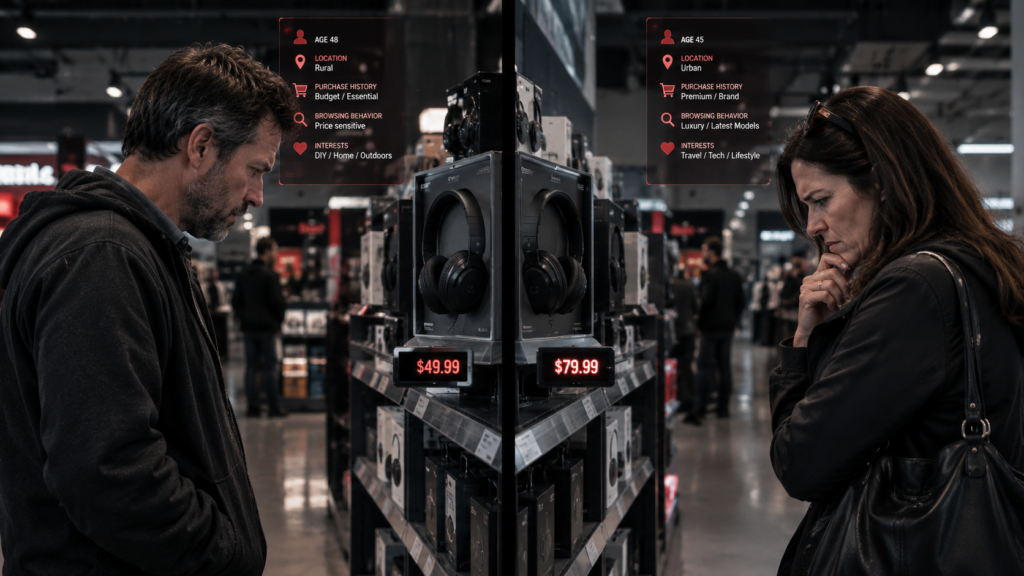
Everywhere we look, companies are finding new ways to collect information about us, predict our behavior, and turn that information into profit.
Prices change constantly.
The same product may cost more depending on when we look at it, where we live, what device we use, how long we leave it in our shopping cart, or what a company thinks we are willing to pay.
At the same time, digital stores continue to present transactions as purchases while their legal agreements often define those purchases as limited licenses that can be restricted, revoked, or made inaccessible.
I believe this is more than an unfortunate side effect of new technology.
When companies use algorithms, personal data, and consumer behavior to determine what people are charged—without clearly explaining how those prices are calculated—it becomes an amoral and unchecked form of deceptive behavior.
It is invasive because consumers may not know what information is being collected, how that information is being interpreted, or whether their privacy is influencing the price they see.
The fact that they are legally allowed to collect your personal information is a problem anyway.
The same problem appears in digital marketplaces, where companies may present a transaction as a purchase while their legal agreements define it as only a limited license. Consumers are being asked to pay as though they are buying something outright, while companies retain control over access, ownership rights, accounts, and distribution.
Technology is advancing faster than laws and consumer protections can keep up with.
I believe laws should be in place to protect consumers from these practices.
Companies shouldn’t be allowed to collect your personal information for any reason.
Since they are.
Companies should be required to disclose when prices are personalized, explain what types of data influence pricing, prohibit the use of sensitive personal information to determine prices, and make it clear when a digital transaction provides only a license rather than ownership.
Consumers should not have to fight through legal agreements, algorithms, and corporate secrecy just to understand what they are paying for.
These companies shouldn’t be able to hide behind a 40,000 word essay of legal jargon for a video game, or movie purchase, let alone a carton of eggs or gallon of milk.
The problem is not simply that prices change.
The deeper problem is the combination of algorithmic control, personal data, limited transparency, essential purchases, weak consumer bargaining power, and legal agreements designed primarily to protect the company.
That combination turns ordinary consumers into targets for extraction rather than participants in a fair transaction.
That is why I believe this represents the newest form of anti-consumerism.
The consumer is no longer treated simply as a customer.
They are treated as a data point, a prediction, a target, and a source of maximum possible revenue.
The system is becoming more and more predatory with the increased invasion of privacy that has almost no regulation.
What Is Dynamic Pricing?
Dynamic pricing is the practice of changing prices based on changing conditions.
Companies may adjust prices because of supply and demand, inventory levels, competitor prices, time of day, seasonality, or other market conditions.
Dynamic pricing is not new. Airlines, hotels, rideshare companies, ticket sellers, and many other businesses have used changing prices for years.
But modern technology has made these systems faster, more complicated, and much harder for ordinary consumers to understand.
A company no longer has to manually change a price.
An algorithm can monitor thousands of data points and adjust prices automatically.
The company can potentially react to demand in real time, change prices across thousands of products, and analyze consumer behavior at a scale that would have been impossible in the past.
The issue is not merely that a price changes.
The issue is who controls the change, what information is being used, and whether the consumer is being told the truth about why they are being charged a particular amount.
There is a major difference between a business changing a price because its wholesale costs increased and a company examining a customer’s behavior to estimate the maximum amount that customer might pay.
One is a traditional business decision. Simple elementary school economics.
The other begins to resemble surveillance-based extraction. This is no different than a burglar casing your home waiting for you to be gone and stealing your valuables.
Walmart and the Expansion of Algorithmic Pricing
Walmart has become one of the companies at the center of concerns about algorithmic pricing.
In March 2026, reporting revealed that Walmart had received patents involving artificial-intelligence tools for pricing decisions. The patents included technology related to dynamically and automatically updating item prices.
You can read more in Gizmodo’s report on Walmart’s AI-powered pricing patents.
A patent does not automatically prove that a company is using every part of the patented technology in its stores. But that does not make the development harmless or irrelevant.
It shows that major retailers are actively developing systems capable of changing prices through automated technology.
Walmart has denied that it is using dynamic or surge pricing in the way critics fear.
But I do not believe consumers should simply accept a corporate denial and stop asking questions.
There are several videos showing the price changes on the internet. There’s also an article from the New York Post about the $3 sneaker incident.
Here’s the link: https://nypost.com/2026/05/26/lifestyle/angry-walmart-shopper-hit-with-dynamic-price-in-real-time/
The concern is not imaginary. The technology is real. The patents are real. The ability to change prices quickly and automatically is real.
And once these systems are in place, consumers have very little power to determine how they are used.
Digital Price Tags and the Grocery Store
Walmart has also been expanding the use of electronic shelf labels, which allow stores to change prices digitally rather than replacing paper tags by hand.
According to Forbes, Walmart has discussed rolling out digital price tags across its U.S. stores by the end of 2026.
Walmart has said that the shelf price is intended to remain the same for everyone in a particular store. But the concern is obvious: electronic shelf labels create the infrastructure needed to change prices quickly, frequently, and at scale.
That matters even more when the products involved are groceries, medicine, household necessities, and other items people cannot simply stop buying.
A consumer shopping for entertainment has more flexibility than a parent trying to buy food for their children.
A person purchasing a luxury item may be able to wait. I can do without the candy bar or the new TV.
A person who needs medication, transportation, or basic groceries may not have that option.
The possibility of rapidly changing prices for necessities should concern everyone.
A September 2026 report discussed by The Guardian warned that widespread adoption of electronic shelf labels could contribute to both job losses and higher grocery prices.
The report estimated that electronic shelf-label adoption could result in approximately 44,223 to 191,633 job losses and between $1.6 billion and $6.9 billion in lost wages annually.
The report also argued that electronic shelf labels could make dynamic and surveillance-based pricing easier to implement across the grocery industry.
That is a serious concern for both consumers and workers.
The technology may reduce the need for employees to manually change prices while giving companies greater control over how quickly prices can be adjusted.
Consumers could face more unpredictable prices, while workers could lose another part of their jobs to automation.
That is not progress for everyone.
It is progress for the corporation’s ability to control the transaction.
Questions From Congress
In May 2024, Senator Sherrod Brown questioned Amazon and Walmart about their use of pricing algorithms and so-called dynamic pricing.
The U.S. Senate Banking Committee’s statement raised concerns about whether companies could use information such as:
- A consumer’s location
- The time of day
- The electronic device being used
- Consumer behavior
- Other personal or market data
These questions matter because the price a consumer sees may not always be based on the product itself.
It may be based on the company’s assessment of the person standing on the other side of the screen.
It can be a form of digital discrimination.
That is a dangerous shift in the relationship between businesses and consumers.
Amazon and the Price That Keeps Moving
Amazon is one of the clearest examples of algorithmic pricing at scale.
Prices on Amazon can change constantly based on factors such as:
- Competitor prices
- Inventory levels
- Demand
- Sales history
- Seasonal trends
- Shipping costs
- Market conditions
- Seller pricing tools
- Automated repricing systems
Industry explanations of Amazon’s pricing systems can be found through sources such as Pricefy, Influencer Marketing Hub, and My Amazon Guy.
These sources describe how automated pricing systems can respond to market conditions and competitor activity.
But one problem is that the consumer does not have the same visibility into those systems.
A seller may know exactly why a price changed.
Amazon may know which factors influenced the price.
The consumer usually sees only the final number. Without knowing what got them to that price.
The price appears on the screen, and the consumer is expected to accept it.
No, questions asked, no recourse if they find out they were scammed.
That imbalance of information gives the company enormous power.
An “imbalance of information”, most of that information should be private to begin with.
When Algorithmic Pricing Affects Public Institutions
The concerns become even more serious when algorithmic pricing affects schools, municipalities, and other public institutions.
A report discussed by The Guardian examined pricing on Amazon Business and analyzed purchases made by public entities.
The analysis reportedly examined 23 public entities and found that they could have saved an average of approximately 17 percent if they had consistently obtained the lowest available prices.
The report also found that Denver Public Schools may have spent nearly $1 million more than necessary on certain purchases in 2023.
Another example involved a 12-pack of Sharpie markers. One public entity reportedly paid $8.99, while Denver Public Schools paid $28.63 for the same type of product.
A stapler was reportedly listed at $15.39 at one point and later at $61.87.
A separate report from Yahoo Finance discussed research suggesting that public institutions may have spent approximately $3 million on supplies that could have cost closer to $2.5 million if the lowest available prices had been secured.
These figures come from an analysis whose methodology and conclusions can be debated. But even the existence of these findings should be alarming.
Schools and local governments are not simply wealthy private shoppers.
They are spending taxpayer money.
When a public institution pays more for basic supplies, that money is no longer available for classrooms, public services, infrastructure, or community needs.
And when pricing systems make it difficult to determine why one organization pays more than another, the public is left with very little ability to challenge the transaction.
This is not just about a company changing a price.
It is about corporations using complicated pricing systems in environments where the buyer may not have the time, information, or bargaining power to fight back.
“Supply and Demand” are being weaponized against the consumer.
Sony and the Problem of Personalized Digital Pricing
Sony has also faced criticism over pricing practices on the PlayStation Store.
Reports have described situations in which different customers appeared to see different prices for the same digital games depending on the account being used.
TechRadar reported on Sony testing dynamic pricing on PlayStation 5, including reports involving games such as Star Wars Jedi: Fallen Order and Star Wars Jedi: Survivor.
Sony is using pricing systems that can result in different customers seeing different prices for the same digital games.
That is unacceptable to me.
If two people are attempting to purchase the exact same digital product at the same time, they should not have to wonder whether one of them is being charged more because of their account history, purchasing habits, location, previous behavior, or perceived willingness to pay.
The consumer should not be expected to investigate the company’s algorithms just to determine whether they are receiving a fair price.
Sony should not be able to hide behind technical explanations, vague policies, or complicated terms of service while consumers are left wondering why one person is offered a different price than another for the exact same product.
An 8 year old shouldn’t be bound by an EULA that they don’t understand. They shouldn’t be spied on and data collected about their habits and behavior.
This is not a harmless experiment.
It is another example of a company using technology to gain more control over the consumer while providing little meaningful transparency in return.
Dynamic Pricing, Personalized Pricing, and Surveillance Pricing
These terms are related, but they are not identical.
Dynamic pricing
Dynamic pricing means that prices change over time or in response to changing conditions.
Examples may include:
- Higher hotel prices during a major event
- Increased rideshare prices during periods of heavy demand
- Airline prices changing as seats sell
- Retail prices changing based on inventory or competition
Algorithmic pricing
Algorithmic pricing means that software or automated systems determine or recommend prices using rules, data, or predictive models.
An algorithm may consider demand, supply, competitors, inventory, or consumer behavior.
Personalized pricing
Personalized pricing means that different consumers may receive different prices based on information associated with them.
That information could include:
- Browsing history
- Shopping history
- Location
- Household information
- Device information
- Account activity
- Previous purchases
- Inferred income or spending habits
Surveillance pricing
Surveillance pricing is an especially troubling form of personalized pricing in which companies use personal information and behavioral data to estimate what a particular person might be willing or able to pay.
This is where the practice becomes particularly invasive.
A company may not simply be asking, “What does this product cost?”
It may be asking, “How much can we charge this specific person before they refuse to buy it?”
Price discrimination
Price discrimination occurs when different customers are charged different prices for the same or similar goods or services based on particular characteristics or circumstances.
Some forms of price discrimination have existed for a long time.
Modern data collection, however, gives companies the ability to make these decisions at a much more detailed and secretive level.
Digital licensing
Digital licensing occurs when a consumer pays for access to a digital product but does not necessarily receive ownership of that product in the same way they would own a physical item.
This is especially important in digital games, movies, music, books, software, and other products tied to accounts or online platforms.
These categories can overlap.
A company could use algorithmic technology to change prices dynamically, personalize those prices based on consumer information, and sell the product through a digital license rather than transferring traditional ownership.
That combination gives the company an extraordinary amount of power.
Sony, Digital Purchases, and the Meaning of “Buy”
The pricing issue is only part of the problem with digital marketplaces.
The other issue is what consumers are actually purchasing.
When a person visits the PlayStation Store and sees a button that says “Buy Now” or “Confirm Purchase,” the ordinary meaning is that the person is buying something.
But the legal agreement may define the transaction as a license rather than ownership.
That means the company may retain significant control over the product, the account, the platform, and the consumer’s continued access.
You can lose access to your account for whatever reason the license holder deems unacceptable in their Terms of Service that constantly change. They took your money just like a bully on the playground. You have no recourse no nothing.
In June 2026, four California gamers sued Sony Interactive Entertainment, alleging that the language used in the PlayStation Store could mislead consumers into believing they were purchasing ownership of digital games rather than receiving limited licenses.
The lawsuit is connected to California’s AB 2426, a law addressing how digital goods are advertised and whether companies must clearly disclose when consumers are receiving a license instead of ownership.
Aftermath reported on the lawsuit against Sony.
The case reportedly concerns the PlayStation Store’s use of terms such as “Buy Now” and “Confirm Purchase.”
Sony has argued that reasonable consumers would not be misled because the company’s legal terms explain that digital games are licensed rather than owned.
That is the weakest statement that I have heard. Here’s why.
And I have a serious problem with the argument that every reasonable person understands that they are not actually purchasing a video game, but are instead purchasing a license to use software.
That statement assumes far more than it proves.
Sony may understand the legal distinction between ownership and licensing. Its lawyers certainly understand it. But why should we assume that every ordinary consumer understands it too?
Especially children.
A child can save their money, walk into a store, and buy a video game. They can receive one as a birthday present. They can borrow one from a friend. They can download a free game. They can put a disc into a PlayStation and start playing.
From their perspective, they got a video game.
Are we really going to argue that a child automatically understands that they did not actually purchase the software, but instead entered into a legally binding licensing arrangement governing their use of that software?
What part of that transaction would reasonably communicate that to them?
The box says it’s a game. The store sells it as a game. The money is exchanged for the game. The disc looks like a physical product. The child takes it home and plays it.
Then somewhere in the legal documentation, the company tells them that they actually received a license rather than ownership.
That may be the company’s legal position, but it doesn’t magically make the distinction obvious to the person playing the game.
And this isn’t just a problem with children.
Parents can have the exact same misunderstanding.
A parent who grew up buying video games 25, 30, or 40 years ago has spent decades thinking about games as products. You bought the cartridge. You bought the disc. You took it home. You played it. You could lend it to somebody. You could give it to somebody. You could sell it.
Today, that same parent can buy a PlayStation for their family and buy a game for their child.
Are we seriously going to assume that this parent automatically knows that there may be multiple separate legal agreements governing that experience?
There can be terms governing the PlayStation itself, the PlayStation Network account, the software, online services, and the individual game. Some software may present an obvious agreement. Other software may rely on language saying that simply playing or using the software constitutes acceptance.
And the parent may never see any of it.
They may not know a separate EULA exists. They may not read one. They may not understand one. They may simply believe they purchased a video game for their child.
That matters.
Because there is a massive difference between saying:
“The company has written an agreement stating that the software is licensed.”
and saying:
“Every reasonable person who uses this software understands that they are entering into that licensing agreement.”
The first is a statement about what the company wrote.
The second is a claim about what millions of consumers supposedly understand.
Those are not the same thing.
And when the person using the software is a minor, the assumption becomes even more questionable. Children are not simply treated as miniature adults under contract law. They can have limited contractual capacity, and they may not understand the legal consequences of agreements in the same way an adult does.
Yet the argument that “every reasonable person knows” effectively sweeps all of that aside.
It treats a child who thinks they bought a video game as though they necessarily understood the legal difference between buying a product and receiving a software license.
I don’t think that assumption should be accepted without question.
The fact that a company puts something into a EULA doesn’t mean the average consumer understands it. The fact that lawyers understand a term doesn’t mean a child understands it. The fact that the company considers playing the software to constitute acceptance doesn’t mean the player understood that playing the software was supposedly creating a contractual relationship.
And this is where the modern video-game industry has created an enormous disconnect between the consumer experience and the legal characterization of that experience.
The consumer experience still looks like buying a game.
The legal documentation may say you are licensing software.
Those two things can coexist, but companies should not pretend that the existence of the legal language automatically makes its meaning obvious to everyone.
If Sony wants to argue that every reasonable person knows they are purchasing a license rather than a game, then the obvious question is:
Where would a reasonable child—or even a reasonable parent—necessarily learn that?
Not where does Sony put it in its legal documents.
Not what does Sony’s lawyer understand.
Not what does the EULA say.
Where, during the ordinary experience of buying and playing a video game, is the average consumer clearly told that they are not purchasing the game itself, but are instead entering into a software license with legal restrictions attached to their use of it?
That distinction may be legally important.
But calling it obvious doesn’t make it obvious.
And assuming that everyone understands it—especially children—is exactly the assumption that needs to be challenged.
There’s also one very important detail that they seem to be missing.
If a PlayStation is a product designed to be used by children, why should we assume that a child understands the adult legal language contained in its Terms of Service or EULAs?
Across the United States, minors are generally treated differently from adults when it comes to contracts. Federal consumer guidance recognizes that a lender can refuse to lend to someone who is too young to legally enter a contract, with the specific age determined by state law.
So why should a child be expected to understand and accept a complex software license simply because they can operate a PlayStation?
I’m not arguing that children shouldn’t be allowed to play video games. I’m questioning the assumption that being capable of playing a game means being capable of understanding the legal agreement governing the software.
A 15-year-old can understand how to play a video game without understanding the difference between buying a product and receiving a license to use software under a legal agreement.
And this shouldn’t just be about children. Companies should be making this language clear and concise for all consumers. If an agreement contains terms that are important enough to restrict what a customer can do with something they paid for, then those terms should be explained in language that an ordinary person can actually understand.
Companies shouldn’t be able to hide behind pages of complicated legal jargon and then argue that the consumer should have known what they were agreeing to. If you’re going to tell people that they aren’t actually buying a product, but are instead purchasing a license with restrictions attached, say that clearly and prominently.
Don’t bury important terms in an EULA and then blame the consumer for not understanding them.
And this is where I believe the issue becomes more than just confusing or unfair—it can become nefarious.
If a company intentionally uses complicated legal language, buried terms, or confusing contractual structures because it knows the average consumer is unlikely to understand what they’re actually agreeing to, then that isn’t simply a failure of communication. It is using the complexity of the legal system to its advantage.
If the company would rather hide an important restriction in legal jargon than explain it plainly to the customer, I have to question why.
If a company has a legitimate reason for a restriction, it should be willing to explain that restriction clearly. If the company believes consumers would object to the term if they understood it, hiding that term behind legal language doesn’t make the practice more acceptable. It makes the decision to hide it more troubling.
Legal agreements have a legitimate purpose. But legal jargon should never become a shield for conduct that a company knows its customers may find objectionable. A company should not be able to say, “It’s right there in the agreement,” as though putting something in hundreds of lines of legal language automatically makes the consumer meaningfully aware of it.
If a company believes a term is important enough to enforce against its customers, then it should be important enough to explain clearly to those customers.
A 15-year-old can understand how to play a video game. A parent can understand that they bought their child a game. What they should not be expected to automatically understand is a complicated legal agreement that the company never clearly explained to them.
Those are two completely different kinds of understanding.
But this is exactly the problem.
Companies should not be able to advertise a transaction as a purchase and then rely on lengthy legal agreements to redefine what the consumer supposedly understood.
The average customer is not reading every paragraph of a licensing agreement before clicking “Buy Now.”
The wording on the storefront matters.
The presentation matters.
The ordinary meaning of the transaction matters.
If a company wants to sell a limited license rather than ownership, it should say so clearly and prominently before the consumer pays.
It should not use purchase language to encourage the transaction and then use legal language afterward to limit the consumer’s rights.
Sony’s Conflicting Messages About Ownership
The controversy has become even more complicated because Sony has reportedly used language in other places suggesting that consumers do, in fact, own their games.
That contradiction is difficult to ignore.
If Sony wants consumers to understand that they are purchasing only a license, then the company should consistently and prominently use language that communicates that fact.
It should not tell consumers they own something in one context and then argue in court that they should have understood they owned nothing in the traditional sense.
The lawsuit is still a legal dispute, and it has not produced a final ruling establishing that Sony violated the law.
But the underlying issue is legitimate.
Consumers deserve to know what they are buying.
What Happens When Digital Purchases Disappear?
Physical products are not perfect, but they provide a form of control that digital products often do not.
If someone buys a physical game, disc, book, movie, or other item, they generally possess a physical object that can be used, resold, loaned, stored, or kept independently of a company’s online account system.
Digital products can be different.
Access may depend on:
- A user account
- A platform
- A server
- A company’s licensing agreement
- Continued technical support
- Storefront availability
- Digital rights management
- Compatibility with future hardware
- A company continuing to recognize the purchase
If an account is suspended, a platform shuts down, a server disappears, a storefront closes, or a company changes its licensing rules, consumers may lose access to products they believed they had purchased.
That is why I do not think companies should be allowed to present digital transactions as ordinary purchases while quietly retaining the ability to control access.
The consumer pays up front.
The company keeps the legal control.
And if something goes wrong, the consumer may have little practical ability to recover the product.
This is not a minor technical distinction.
It affects the value of the transaction.
It affects the consumer’s rights.
It affects whether a person can preserve something they paid for.
As Kiplinger explains, consumers often do not truly own digital purchases in the same way they own physical media.
That should be disclosed plainly rather than buried in legal agreements.
The Federal Trade Commission Is Finally Paying Attention
The Federal Trade Commission has been examining personalized pricing and the use of consumer data in pricing decisions.
In August 2026, the FTC proposed a policy focused on transparency around personalized pricing.
The proposal would address situations in which companies use personal information—such as browsing behavior, location, shopping habits, or other data—to determine individual prices.
The FTC’s official announcement is available here.
The FTC has also described examples involving data such as:
- A person’s location
- Browsing history
- Shopping behavior
- How long an item remains in a virtual shopping cart
- Household information
- Other information used to estimate willingness to pay
According to reporting from Reuters, the FTC’s position is that consumers generally expect a listed price to be the price available to everyone, rather than a retailer’s private estimate of how much a particular person might pay.
That expectation is reasonable.
When consumers see a price displayed on a website, they should not have to wonder whether the company has secretly calculated a different price for them.
The FTC’s proposal is an important step, but it is not enough.
These companies shouldn’t be allowed to put you against yourself.
The proposal focuses heavily on disclosure.
Disclosure alone does not necessarily make a practice fair.
A company could tell consumers that it is using personal data to influence prices and still continue charging them more because of that information.
That is not the same thing as protecting consumers.
The FTC’s proposal also does not ban every form of personalized pricing.
That means companies could still potentially use these systems as long as they meet certain disclosure requirements.
I believe stronger protections are necessary.
I want to make a quick comparison.
Consider the way we treat wiretapping.
We recognize that a person’s communications are private and that there are legal limits on when someone can secretly intercept or record them. In many circumstances, consent matters. You generally can’t just secretly obtain someone’s private information and use it however you want simply because the technology makes it possible.
So why should the standard be completely different when a company collects personal information about a consumer and uses that information to determine the price that particular person is shown?
If a company knows my location, purchasing history, browsing behavior, device information, or other personal data and uses that information to determine how much I personally will be charged for the same product, that’s no longer simply a matter of supply and demand. The company is using information about me to make an individualized pricing decision.
The question shouldn’t simply be, “Did the company technically disclose somewhere in its privacy policy that it collects this information?”
The question should also be, “Did the consumer meaningfully understand that their personal information could be used to determine the price they are offered?”
We have recognized that there are circumstances where the collection and use of personal information requires meaningful consent or legal limitations. Dynamic pricing based on personal information deserves that same level of scrutiny.
I’m not saying personalized pricing is legally the same thing as wiretapping. It isn’t.
I’m saying the comparison exposes an important principle:
Just because technology makes it possible to collect and use personal information doesn’t mean companies should automatically be entitled to use that information in whatever way they choose.
If a company is going to use information about me to determine what I pay, I believe I should be clearly told that this is happening—not have it buried in pages of legal jargon and discover later that the price I received was based partly on information the company had collected about me.
Consent should mean understanding what you’re consenting to, not simply agreeing to whatever a company can fit into a privacy policy.
Consumers should not have to agree to be surveilled in order to purchase groceries, medicine, transportation, housing-related services, or other necessities.
States Are Beginning to Push Back
Federal action has been slow, but several states have begun introducing or passing laws addressing personalized, algorithmic, and surveillance-based pricing.
The details matter because there is a major difference between:
- A bill being introduced
- A bill passing one legislative chamber
- A bill becoming law
- A law taking effect
- A law being enforced
Connecticut
Connecticut has adopted legislation requiring warnings when a price has been increased through a pricing device using a consumer’s personal data.
The law is expected to take effect in October 2026.
According to CT Insider, the disclosure may use language such as:
“This price was increased by a price setting device using your personal data.”
The law applies to online and physical transactions and can affect delivery services and other businesses.
This is an important acknowledgment that consumers deserve to know when personal information is being used to influence what they pay.
But again, a warning is not the same as a ban.
A company may still be able to charge more based on personal data if it provides the required disclosure.
New York
New York officials have also pushed for stronger protections against surveillance pricing.
In March 2026, New York Attorney General Letitia James called for passage of legislation addressing predatory pricing practices.
The proposed One Fair Price Package would address surveillance pricing and electronic shelf labels.
The proposal is discussed in the New York Attorney General’s announcement.
New York’s efforts show that the issue is no longer limited to consumer advocates or technology critics.
State officials are beginning to recognize that algorithmic pricing can create serious problems involving privacy, fairness, and corporate power.
Maryland
Maryland became the first state reported to have passed a law specifically banning personalized pricing in grocery stores.
Consumer Reports discussed Maryland’s law.
The law includes exemptions, and those exemptions may limit how much protection consumers ultimately receive.
Still, the law represents an important shift.
Grocery stores sell products that people need to survive.
Allowing companies to use personal information to determine how much a particular household pays for food creates an unacceptable risk of exploitation.
A Broader Legislative Movement
A March 2026 report from Inside Privacy described a new wave of state legislation involving personalized algorithmic pricing.
The report stated that more than 40 bills across at least 24 states had been introduced in 2026.
Not every bill will pass.
Not every passed law will have the same protections.
And some proposals may be weakened by exemptions, delays, or enforcement limitations.
But the movement is significant.
Consumers are beginning to recognize that pricing systems can be used not only to respond to the market, but to exploit private information and unequal bargaining power.
Instacart and the 23 Percent Problem
Instacart has faced serious criticism over AI-driven pricing experiments.
In December 2025, Consumer Reports reported that the same grocery items from the same store and at the same time could be offered to different shoppers at different prices.
Some of the price differences were reportedly as high as 23 percent.
Instacart denied that it was using personal or demographic information in the experiment and said that shoppers were placed into randomized groups.
But the result remains deeply troubling.
If two consumers are looking at the same product from the same store at the same time, why should one person be shown a higher price?
Even if a company claims that the differences were caused by randomized testing rather than personal information, consumers are still being used as experimental subjects in a pricing system they do not control.
The company is testing how much people will pay.
The consumer is the one who carries the risk.
The company’s decision to stop the practice does not erase the underlying problem.
It shows that public pressure, investigations, and consumer criticism can force companies to reconsider practices they might otherwise continue.
It also raises a basic moral question:
Why was this considered acceptable in the first place?
Why I Believe Laws Are Necessary
This is ultimately where I land.
I believe there should be laws protecting consumers from the most invasive and deceptive forms of algorithmic pricing.
I do not believe the government needs to outlaw every price change.
I do not believe businesses should be prohibited from responding to supply, demand, inventory, competition, or legitimate market conditions.
This is just basic economics that we’ve dealt with as long as there has been society.
But I do believe consumers deserve basic protections.
Companies should have to disclose when prices are personalized.
This should be before you have bought the item or service.
They should have to explain what categories of personal information influence pricing.
Sensitive personal information should not be used to determine how much an individual consumer pays.
Basic necessities should be off limits, groceries, medication, utilities for example.
Consumers should know when they are being shown a personalized price rather than a standard price.
And when a product is sold as a digital purchase but the customer is actually receiving a limited license, that should be made clear before the transaction is completed.
Not buried in a massive legal agreement.
Not hidden behind another link.
Not written in language that requires a lawyer to understand.
Clear language. Clear disclosure.
I do not think that is too much to ask.
Important Distinctions
To make this argument persuasive without overstating the evidence, these terms need to remain separate.
| Term | Meaning |
| Dynamic pricing | Prices change over time because of demand, inventory, competition, timing, or other market conditions. |
| Algorithmic pricing | Software or machine-learning systems help determine or update prices. |
| Personalized pricing | Different customers may receive different prices based on information about them. |
| Surveillance pricing | Personal data is collected and analyzed to estimate what an individual customer might pay. |
| Price discrimination | Different prices are charged for the same or similar product based on customer characteristics or circumstances. |
| Digital license | A customer receives permission to access or use digital content rather than owning the content in the same way as a physical item. |
These distinctions matter.
If we start calling every changing price “surveillance pricing,” the argument becomes weaker.
If we start treating every electronic shelf label as proof of price manipulation, the argument becomes weaker.
If we say every company using a pricing algorithm is exploiting consumers, the argument becomes weaker.
We do have to be vigilant because if you’re not paying attention it could cost you.
The stronger argument is much more specific.
The technology creates the ability to do things consumers may not realize are possible.
And some companies are already experimenting with those capabilities.
That deserves scrutiny.
Is Every Form of Dynamic Pricing Immoral?
I do not believe every price change is automatically immoral.
Businesses face changing costs.
Supply chains fluctuate.
Demand changes.
Some industries have used variable pricing for decades.
But that does not excuse every form of algorithmic pricing.
There is a difference between adjusting a price because a product costs more to obtain and using personal information to determine how much a particular customer can be pressured into paying.
There is also a difference between changing the price of a luxury product and changing the price of something people need to survive.
Consider these examples:
- A company increases the price of allergy medication when pollen counts rise.
- A delivery service charges more because it knows a household has multiple children.
- A hotel charges more because an algorithm determines that a customer is traveling for a funeral.
- A retailer charges more because a customer lives in an area with fewer alternatives.
- A company increases a price because a shopper repeatedly viewed the same product.
- A platform charges more because it believes a customer is desperate or unlikely to comparison-shop.
- A digital storefront presents different prices to different account holders for the same game.
These practices are not simply neutral uses of technology.
They are decisions about how much suffering, urgency, convenience, or desperation a company can convert into revenue.
That is why I believe many of these practices are amoral.
They treat people as sources of extraction rather than as customers deserving honesty and fair treatment.
Your own life is being used to affect how you buy, how you live, what you buy.
Privacy Should Not Be a Pricing Variable
The privacy issue is just as important as the price itself.
Consumers often do not know:
- What data is being collected
- How long that data is stored
- Which companies receive it
- Whether the data is combined with information from other sources
- Whether the data is used to estimate income
- Whether the data is used to predict desperation
- Whether the data is used to calculate willingness to pay
- Whether the data affects the price displayed on the screen
A person may believe they are simply browsing for groceries, a hotel room, a game, or a household product.
Behind the scenes, the company may be collecting information about their habits and using that information to make financial decisions about them.
That is invasive.
A person should not have to surrender their privacy to receive a fair price.
And a company should not be allowed to hide behind the complexity of its algorithms.
If personal information influences a price, the consumer deserves a clear explanation.
If sensitive information is being used, that practice should be prohibited.
If a company cannot explain how a price was calculated, then consumers should have every reason to question whether the system is fair.
The Consumer Has Almost No Bargaining Power
The most disturbing part of these practices is the imbalance of power.
Large corporations have:
- Massive amounts of consumer data
- Teams of lawyers
- Engineers who build pricing systems
- Economists and analysts
- Automated decision-making tools
- Detailed purchasing histories
- The ability to test different prices
- The ability to change policies across millions of transactions
The individual consumer usually has none of that.
A consumer sees a price and must decide whether to pay it.
They generally cannot inspect the algorithm.
They cannot demand the company’s internal data.
They cannot negotiate with a digital storefront.
They cannot easily determine whether another customer received a lower price.
They may not even know that a different price was available.
That is not a fair contest.
It is a system in which the company has information and control while the consumer has limited visibility and few alternatives.
This is especially dangerous when the product is essential.
People need food.
People need medicine.
People need transportation.
People need housing.
People need internet access.
People need basic household supplies.
When companies use personal information and algorithmic systems to extract more money from people who cannot simply walk away, the practice becomes exploitative.
What Consumer Protection Should Look Like
I believe lawmakers should establish clear protections around algorithmic and personalized pricing.
At a minimum, companies should be required to:
- Clearly disclose when a price is personalized.
- Explain what categories of data influence the price.
- Tell consumers whether browsing history, location, account activity, household information, or purchasing behavior affects the price they see.
- Prohibit the use of sensitive personal information to determine prices.
- Prohibit companies from charging different consumers different prices for the same essential goods based on private behavioral profiles.
- Require companies to maintain clear records of how automated pricing decisions are made.
- Give consumers a meaningful way to challenge an automated price.
- Require prominent disclosures when a digital transaction provides only a license rather than ownership.
- Prevent companies from using “Buy Now” language when the consumer is not receiving ownership in the ordinary sense.
- Provide real penalties for deceptive or hidden pricing practices.
A company should not be able to bury the truth in a legal agreement that almost nobody reads.
A company should not be able to hide behind the phrase “the algorithm did it.”
And a company should not be able to argue that consumers accepted a practice they were never clearly told about.
The Newest Form of Anti-Consumerism
For years, consumers have dealt with companies that raised prices, reduced product quality, added fees, weakened warranties, and made customer service increasingly difficult to access.
Algorithmic pricing adds another layer to that problem.
Now companies can potentially use personal data, consumer behavior, and predictive technology to determine how much each person can be charged.
Digital licensing adds another layer by allowing companies to sell access while retaining control over the product.
The result is a marketplace where consumers may face:
- Prices they cannot explain
- Terms they cannot easily understand
- Products they do not truly own
- Accounts that can be restricted
- Purchases that may become inaccessible
- Algorithms they cannot inspect
- Companies that deny responsibility for automated decisions
- Legal agreements designed primarily to protect the corporation
That is why I believe algorithmic greed is the newest form of anti-consumerism.
The consumer is no longer treated simply as a customer.
They are treated as a data point.
A prediction.
A target.
A behavioral profile.
A source of maximum possible revenue.
The company’s goal becomes not simply to sell a product at a fair price, but to determine the highest amount it can extract from each individual person.
That is not a relationship built on trust.
It is a relationship built on surveillance, secrecy, and unequal power.
Final Thoughts
I do not believe consumers should have to accept these practices as inevitable.
Technology does not automatically make a practice ethical.
An algorithm does not make exploitation acceptable.
A legal agreement does not make deceptive advertising honest.
And a corporate denial does not erase the concerns created by the company’s own technology, policies, and behavior.
The issue is not simply whether prices change.
The issue is whether companies are using technology and personal information to manipulate consumers while refusing to provide meaningful transparency or accountability.
The issue is whether a person is buying a product or merely purchasing temporary access controlled by a corporation.
The issue is whether consumers have any meaningful ability to challenge the prices they are shown.
And the issue is whether lawmakers are willing to protect ordinary people before these systems become too deeply embedded in everyday life to regulate.
I believe this is more than an unfortunate side effect of new technology.
I believe it is an amoral and unchecked form of deceptive behavior.
I believe it is invasive.
I believe it is anti-consumer.
And I believe laws should protect people from being treated as targets for extraction simply because a company has enough data to predict what they might be willing to pay.
This is what I am finding in my research.
These are my opinions, and I know not everyone will agree with them.
But I believe consumers deserve better.
Was there anything I missed?
About The Exploited Worker 138
The Exploited Worker 138 is an independent publication exploring work, layoffs, unemployment, artificial intelligence, automation, the economy, technology, and what it means to rebuild in a changing world.
The goal isn’t to pretend we have all the answers.
It’s to have the conversations that often don’t happen until after the job is gone.
Starting Over in a Broken System.