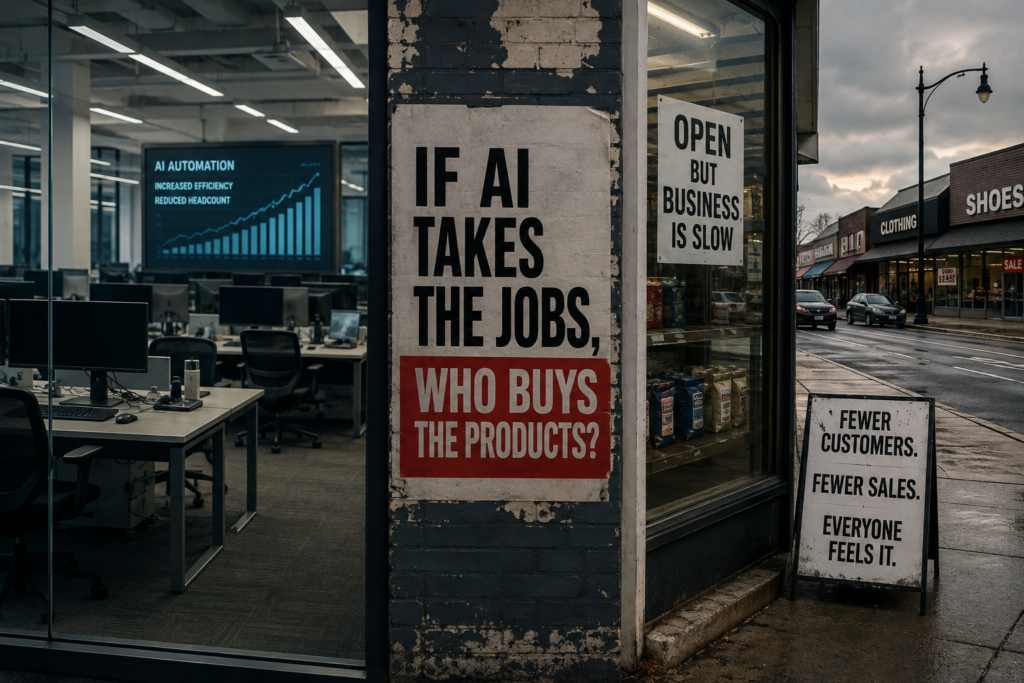
What happens to the consumer economy when people lose the income they use to keep it moving?
Editorial: This article reflects my personal experiences, observations, and opinions about artificial intelligence, employment, automation, and the economy. I’m not arguing that technology itself is bad. I’m asking what happens when the economic benefits of technology aren’t shared with the people whose jobs and income are affected by it.
If AI Takes Enough Jobs, Who Buys the Products?
Lately I’ve been thinking about a question that I can’t seem to get out of my head.
If AI takes enough jobs… who buys the products?
Seriously.
Think about it for a minute.
Every company wants customers.
Every company wants sales.
Every company wants growth.
But customers need money.
And for most people…
Money comes from work.
That’s how the economy has always worked.
People work.
People earn money.
People spend money.
Businesses grow.
Workers get paid.
The cycle continues.
But what happens when companies start replacing workers with software?
Not one company.
Not one industry.
Many companies.
Many industries.
All at the same time.
That’s the question I’ve been wrestling with.
AI Isn’t Coming Someday
The reason it hits close to home is because I’m seeing technology change workplaces in real time.
I’m a seasonal employee.
Recently my hours and income were reduced by roughly 40 percent. Partially because of AI.
And like many workers, I’m looking around wondering what work will look like five years from now.
Ten years from now.
Because AI isn’t coming someday.
It’s already here.
Customer service.
Data entry.
Basic programming.
Writing.
Research.
Scheduling.
Administrative work.
The list keeps growing.
I’m Not Anti-Technology
Now before anyone jumps into the comments…
I’m not anti-technology.
It’s how businesses implement these technologies and how it affects employees.
Technology has always changed work.
Farm equipment changed farming.
Machines changed manufacturing.
Computers changed offices.
The internet changed everything.
That’s not new.
What’s different is the speed.
And the scale.
Because previous technological changes often created new jobs while eliminating old ones.
The question many workers are asking now is:
Will that happen again?
Or will this be different?
Because AI has the potential to affect a much broader range of jobs and tasks than previous technologies.
And that raises questions that go beyond individual employment.
It raises questions about the economy itself.
What Happens When People Stop Spending?
Because if millions of people lose income…
Those people stop spending.
They stop buying new cars.
They delay buying homes.
They cancel subscriptions.
They stop eating out.
They cut everything except necessities.
And when that happens…
Businesses feel it.
That’s why I keep coming back to this question.
If enough people are replaced…
Where does the consumer economy go?
Who buys the products?
Who pays the rent?
Who keeps local businesses alive?
Who keeps the system moving?
A company might save money by reducing its workforce.
But people aren’t just employees.
People are also customers.
The same people companies want to make products for are the people earning the money necessary to buy those products.
And that’s the part of this conversation I think gets overlooked.
The Corporate Side of the Conversation
I don’t pretend to have all the answers.
Honestly, I think we’re all trying to figure it out.
But I do think employees and consumers, actual people, deserve to be part of that conversation.
Because we’re the ones living with the consequences.
The people making decisions often talk about:
Efficiency.
Productivity.
Cost savings.
Automation.
Growth.
Those may be considered legitimate business concerns to those in charge.
People talk about something different.
Paychecks.
Bills.
Families.
Housing.
Food.
Security.
Both conversations matter.
But one conversation tends to get a lot more attention than the other.
The corporate conversation is about what companies can save.
The worker’s conversation is about what happens when they can’t earn enough to survive.
And sometimes it feels like the side getting the most attention doesn’t care about the other.
We’ve Already Seen Massive Job Cuts
We’ve already seen major corporations announce significant workforce reductions in recent years.
And these aren’t small numbers.
Microsoft cut approximately 15,000 jobs in 2025 and another 4,800 in 2026.
Amazon announced approximately 14,000 corporate cuts in October 2025, followed by another 16,000 in January 2026, bringing that restructuring effort to roughly 30,000 corporate jobs since October. Amazon has tied some of these efficiency efforts directly to AI and automation.
Meta cut approximately 3,600 employees in 2025, representing about 5% of its workforce at the time. In 2026, Meta carried out another round of approximately 8,000 layoffs, or about 10% of its workforce, as it reorganized around artificial intelligence.
Salesforce eliminated approximately 4,000 customer-support positions in 2025, with CEO Marc Benioff explicitly connecting the reduction to AI agents. Salesforce then cut fewer than 1,000 additional positions in February 2026, followed by another 86 positions reported in June.
That gives us approximately:
| Company | 2025 | 2026 | Combined |
|---|---|---|---|
| Microsoft | 15,000 | 4,800 | 19,800 |
| Amazon | 14,000 | 16,000 | 30,000 |
| Meta | 3,600 | 8,000 | 11,600 |
| Salesforce | 4,000 | ~1,000+ | ~5,000+ |
| Total | 36,600 | ~29,800+ | ~66,400+ |
So, using the publicly reported calendar-year figures above, these four companies alone account for roughly 66,400 job cuts across 2025 and 2026, with the Salesforce figure being approximate because the 2026 figure is reported as fewer than 1,000.
And then there’s Oracle.
I know someone who lost their job at Oracle. Then I saw the same jobs posted again a month later.
Oracle reported that its global workforce declined by approximately 21,000 between May 2025 and May 2026, from about 162,000 employees to 141,000. However, that figure includes both layoffs and attrition, so I wouldn’t simply add those 21,000 to the total above and call it a calendar-year layoff number. Oracle has also acknowledged that AI adoption and deployment can result in workforce reductions.
And that’s only five companies.
Not five industries.
Five companies.
Now, I want to be careful about something here.
Not every one of these jobs was eliminated because of AI.
Some were the result of restructuring.
Some were cost-cutting.
Some were changes in business strategy.
Some were related to over-hiring during the pandemic.
And some were explicitly connected to AI and automation.
The reasons matter.
But the broader pattern matters too.
Companies are spending enormous amounts of money on AI while simultaneously looking for ways to operate with fewer employees.
And when companies discover they can accomplish the same amount of work with fewer people…
That’s going to affect somebody.
What Happens to the Worker?
Imagine a company discovers that AI allows it to do the work of 1,000 employees with 700.
That’s potentially a tremendous increase in productivity.
But what happens to the 300 people who are no longer needed?
Maybe some find other jobs.
Maybe other companies are also making these same cuts.
Maybe new industries emerge.
Maybe workers retrain.
But what happens if the transition happens faster than people can adapt?
What happens to the people who are 40?
What about 50?
Usually the older, more tenured employees are first to go.
People who have spent decades building careers in an industry that suddenly doesn’t need as many workers?
What happens to people who don’t have savings?
What happens to people who are already living paycheck to paycheck?
What happens to people who can’t simply go back to school for four years?
What happens to people whose jobs disappear while they’re still trying to figure out what their next job is supposed to be?
Those aren’t abstract questions.
Those are people’s lives.
The Consumer Is Part of the Equation
I think this is where the question in the title becomes important.
If AI takes the jobs, who buys the products?
Companies need customers.
Customers need money.
Most people get that money through employment.
So if employment changes dramatically, the consumer economy has to change with it.
Maybe the answer is that AI creates enough new jobs to replace the ones it eliminates.
Maybe productivity gains eventually create entirely new industries.
Maybe that is a BIG maybe though, the point of using AI by companies is to lower labor costs so the bad news is most likely that there will be less jobs. But that doesn’t mean there might not be new jobs created.
Maybe workers move into jobs we can’t even imagine today.
I hope that’s what happens.
But hoping isn’t the same thing as having a plan.
And I don’t think we should simply assume everything will work itself out.
People, Employees and Consumers Deserve a Voice in This
I think employees and consumers, actual people, deserve to be part of the conversation about what comes next.
Not just CEOs.
Not just shareholders.
Not just technology companies.
Not just economists.
People. Those who work, those who consume, and those who are affected by these decisions.
Because we’re the people whose lives are being changed by these decisions.
We’re the people paying the mortgages.
Paying the rent.
Buying groceries.
Supporting families.
Paying taxes.
Buying products.
Keeping local businesses alive.
We’re not just an expense on a spreadsheet.
We’re part of the economy.
And when our income disappears, that affects more than just us.
What Happens to Society If AI Really Does Replace Millions of Jobs?
Maybe that’s the real question.
Not whether AI can replace jobs.
It probably can.
Not whether companies will use it.
They already are.
The bigger question is:
What happens to society if it replaces enough jobs that millions of people no longer have enough income to participate in the economy the way they used to?
That’s a question worth asking before we get there.
Because technological progress isn’t automatically bad.
But technological progress without consideration for the people affected by it can create some serious problems.
And if the goal is a stronger economy…
We need people who can actually afford to participate in it.
Capitalism is supposed to be a two-way street.
The problem is large companies are more interested in taking, this can and working like a cancer, cancer kills healthy cells to to feed itself, that is what these companies are doing to our society.
So, you hear the wealthy say that if you try to control or tax them they won’t be able to innovate they are too big to fail.
This gets fed into politics.
People that want workers rights and billion dollar corporations to contribute to society are called communists and socialists.
These companies are allowed to lobby in congress and contribute to the politician that will give them the favorable outcome they are looking for.
This has been shown lately in the US with large tax breaks for the wealthy and large corporations.
These corporations are ones that own the large television networks, newspapers, websites, radio stations, basically every form of information that is supposed to be unbiased has a spin on it that fits the narrative of we can’t tax the rich because they will leave.
We can’t say things that make certain political figures look bad out of fear of retaliation.
I know these are more than just problems that the US faces, this is just my perspective from where I live.
We are all struggling and I just wanted to get that out even though I just went off topic.
I Don’t Have the Answer
I don’t pretend to have the answer.
I am still trying to figure all of this out just like everyone else, and I am frustrated to be completely honest.
Maybe AI will create more jobs than it eliminates.
Maybe it won’t.
Maybe it will completely transform what we consider a job.
Maybe we’ll eventually have to rethink how people earn money and participate in society.
I don’t know.
But I do know that we’re already feeling the pressure.
I hate to tell everyone this but the government won’t give us universal income.
The government already calls things entitlements regardless of the fact that you have paid for most things through taxes, not to mention getting unemployment is very limited right now.
Which is a discussion for another time.
And I don’t think pretending that these changes aren’t happening is going to help anyone.
So What Happens Next?
I’m not against technology.
I’m not against progress.
I’m not against AI.
I’m against pretending that the consequences don’t matter.
I am against being told that I am a number that doesn’t have value, that doesn’t matter to a bunch of already wealthy, heartless CEOs and shareholders, except for the fact that I am valuable to them when they need someone to do the grunt work and when they cut me to save money. While I am hearing them brag about record-breaking profits and that they’re a great employer to work for. That ranks up there with “we’re a family.”
Because behind every automated process is a person whose job may have changed.
Behind every cost-saving measure is a worker who may have lost hours.
Behind every eliminated position is a person who still has rent to pay.
And behind every consumer is a worker who needs enough income to actually be a consumer.
That’s why I keep coming back to the same question.
If AI takes the jobs… who buys the products?
If consumers can’t afford to consume, what happens to the economy?
Maybe that’s the conversation we should be having.
Not just about what AI can do, this isn’t just about AI, this is about every part of corporate thinking that says let’s just cut people to save money.
But about what kind of society we are going to have when it does.
Not everyone can just find a job these days.
And not everyone can “get a job at McDonald’s.”
You also have to have money to go to a trade school.
And what makes everyone think those jobs will be safe?
They’re already trying out robots at restaurants, and soon companies that hire tradespeople will try to automate that to save money.
Then what do we do as a society?
What Do You Think?
Do you think AI will create more jobs than it eliminates?
Do you think we’re headed toward something fundamentally different?
Are you worried about your own job being affected by AI?
Or do you think the benefits of AI will ultimately outweigh the disruption?
I’d genuinely like to hear what you think.
Leave a comment below.
The Exploited Worker 138 exists because I want to have conversations about the things workers are actually dealing with—not just the polished version of the economy we hear about from corporations and headlines.
Starting Over in a Broken System.
These are my personal experiences and opinions. They are shared to encourage honest discussion about artificial intelligence, employment, automation, economics, and the future of work. If your experience or perspective is different, I’d genuinely like to hear it.