This article reflects my personal experiences, observations, and opinions about artificial intelligence, automation, employment, and the changing workplace.
Today I want to talk about AI.
Not from the perspective of someone completely against it.
And not from the perspective of someone who thinks it’s going to magically solve everything.
Because honestly… I use AI.
I see the benefits.
It’s kind of a double-edged sword. It helps me organize my thoughts and optimize my workflow because I am one person trying to manage a new business, now a website, etc. by myself.
I am not trying to deceive anyone or manipulate numbers for a profit at the expense of any other employees. Part of this whole discussion is about the negative pitfalls of AI.
Like everything else that has been invented, I am sure it wasn’t invented originally for malicious intent.
Like everything else, it was twisted and perverted to be used to make companies richer and the rest of us desperate and oppressed.
This very much reminds me of what Einstein went through when his discovery was used to make the atomic bomb.
We shouldn’t be afraid of this technology, but government needs to catch up.
There need to be safeguards for the economy, the media, the environment, and the people.
These large companies have been able to avoid any actual trouble because there’s no regulation.
This needs to change.
But people can benefit from AI.
There are positive uses.
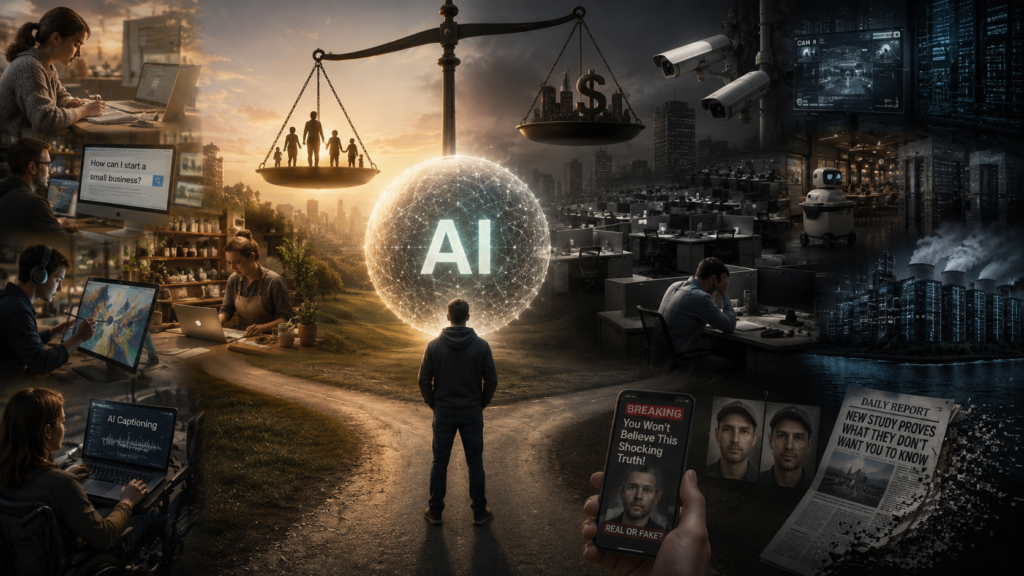
I think too many conversations about AI turn into extremes.
Either:
- “AI is the future and everything will be amazing.”
- or “AI is destroying humanity tomorrow.”
Reality is probably somewhere in the middle.
AI can genuinely help people.
It can save time.
It can make information easier to access.
It can help people work more efficiently.
But it can also create problems at a scale we’ve never really dealt with before.
And I think workers, communities, and ordinary people deserve a realistic conversation about both sides.
The Benefits I Actually See
Let’s start with the positives.
Because there are real positives.
AI is excellent for faster research.
Mostly, there are times that I have to double-check the information because not all AI models are the same, and some incomplete information can cause issues if you need the whole story.
Once again, though, that is because it is there to help, not do the thinking or the entire job for you.
It can summarize large amounts of information in seconds instead of hours.
It can help people with resumes and cover letters.
For someone struggling to organize their experience or explain their skills, that can be genuinely useful.
It can assist programmers by helping debug code, explain concepts, and speed up development.
It can help those of us who can’t code develop applications that they can sell.
I am doing this now.
It can help small businesses compete by handling tasks that used to require larger teams or bigger budgets.
It can improve accessibility for people with disabilities through transcription, speech tools, translation, and other assistive technologies.
And in medical research, AI is already being used to help analyze data, identify patterns, and speed up parts of drug discovery and diagnostics.
Those are real benefits.
I don’t think pretending otherwise helps anyone.
But Here’s What Worries Me
The first thing that worries me is scams.
AI didn’t invent fraud.
But it made fraud easier to scale.
We’re already seeing AI-generated phishing emails, fake customer service messages, voice cloning scams, and deepfake videos being used to manipulate people.
We can still at this point kind of spot issues with video and some photos, but every day that is starting to change. Videos are more believable and photos are starting to show up everywhere. Opportunists and criminals are going to try to deceive you. I am not saying you should be paranoid, but being vigilant has become more important than ever.
The FBI and consumer protection agencies have warned that AI is making scams cheaper, faster, and harder to detect.
That’s not a small problem.
Deepfakes and Misinformation
Another thing that worries me is how AI is changing trust online.
We’re entering a world where seeing is no longer believing.
AI can generate fake videos, fake audio, fake photos, and fake news stories that look convincing.
People have already been fooled by fake celebrity videos, manipulated political content, and AI-generated misinformation.
And the internet is becoming flooded with low-quality AI content.
AI-written articles.
AI-generated reviews.
AI-generated summaries.
AI-generated spam.
The result is that it becomes harder to know what’s real and what isn’t.
We have already had this with social media and news networks falsely reporting things or putting their political agenda above the facts.
There have also been lawsuits in which news organizations were accused of publishing or broadcasting false information, and some of those cases resulted in substantial settlements or court findings.
One of the most prominent examples was Dominion Voting Systems’ defamation lawsuit against Fox News. Dominion accused Fox News and its personalities of repeatedly broadcasting false claims that Dominion’s voting machines had been involved in rigging the 2020 presidential election. In 2023, Fox News agreed to pay $787.5 million to settle the case. The settlement came after a Delaware judge had already ruled that the statements at issue were false. Fox News did not admit liability as part of the settlement.
The Dominion case wasn’t isolated.
Newsmax faced its own defamation lawsuit over reporting about the 2020 election. In 2025, Newsmax agreed to pay $67 million to settle Dominion’s lawsuit, which alleged that the network had spread false claims that Dominion had helped rig the election. Newsmax continued to defend its coverage and said it believed its reporting was fair and balanced.
Newsmax also settled a separate defamation lawsuit brought by Smartmatic, another voting-technology company, for $40 million. The lawsuit involved false claims about Smartmatic and the 2020 election.
And it isn’t limited to conservative media.
In 2024, ABC News agreed to pay $15 million toward Donald Trump’s presidential library to settle a defamation lawsuit over comments made by anchor George Stephanopoulos involving Trump’s civil case brought by writer E. Jean Carroll. The settlement also required ABC to publish a statement expressing regret for the comments.
The details of the underlying E. Jean Carroll case are important because this is exactly the kind of situation where leaving out part of the story can create a misleading impression.
In the first civil case, a jury found Donald Trump liable for sexually abusing E. Jean Carroll and for defaming her, awarding Carroll $5 million in damages. The jury did not find him liable for rape under the specific definition of rape contained in New York law.
Judge Lewis Kaplan later explained that the statutory definition was narrower than the way the word “rape” is commonly understood, and said the jury’s finding was consistent with what many people commonly understand as rape.
A separate jury later found Trump liable for additional defamation and awarded Carroll $83.3 million. The two civil verdicts therefore involved different claims and different damages awards.
ABC’s settlement was specifically over Stephanopoulos’ inaccurate statement that Trump had been found civilly liable for rape. ABC did not issue a finding that Trump had been criminally convicted of rape. The Carroll proceedings were civil cases, not criminal prosecutions.
CNN has also faced successful defamation litigation. In 2025, a Florida jury found CNN liable for defaming U.S. Navy veteran Zachary Young over a 2021 report concerning efforts to evacuate people from Afghanistan. The jury awarded $5 million in compensatory damages. CNN then reached a settlement before the jury could determine punitive damages.
These cases don’t prove that every mistake made by a news organization is intentional.
They don’t prove that one political side has a monopoly on misinformation.
And they certainly don’t mean that everything reported by these organizations is false.
What they do demonstrate is something much simpler:
Major news organizations are capable of getting things wrong, sometimes seriously enough that the issue ends up in court.
And this is only going to get worse now that anyone can generate video and pictures to validate false truths.
A fabricated photograph can be used to support a fabricated story.
A fake video can make it appear that someone said something they never said.
A cloned voice can make a person appear to admit something they never admitted.
And once that material starts spreading through social media, websites, and even legitimate news organizations that are trying to report quickly, correcting the original falsehood may become almost impossible.
The danger isn’t simply that AI will create fake information.
The danger is that people may stop knowing what information deserves their trust.
AI can create information faster than humans can verify it.
Jobs and Human Skills
Then there’s the job issue.
And this is the part that obviously matters a lot for this channel.
AI is already affecting customer service, administrative work, basic writing, data entry, translation, and even some programming tasks.
Even when companies aren’t doing massive public layoffs, many are freezing hiring, reducing entry-level positions, or simply not replacing workers who leave.
The biggest AI layoff may not be a layoff at all.
It may be the jobs that never get posted.
Employers are already making workers use AI as a tool. They are trying to ease it in, saying it’s going to help, not replace the people being misled into using it.
Hoping you don’t notice the layoffs.
Hoping you don’t notice that your workload increased, gradually so you don’t notice that your coworkers are a budget cut or bonuses for management and executives.
Now everyone has to become an expert.
No one can learn on the job anymore.
That worries me because entry-level jobs are how people build experience.
If AI starts handling the beginner tasks, what happens to the people trying to enter those fields in the first place?
It’s not just going to be beginner tasks.
It’s not just white-collar jobs.
It’s going to be service jobs.
You can already see this with robot servers.
Companies want to automate the world for profit.
They want you to rent your entire life.
The Environmental Side
Another thing people don’t talk about enough is the environmental cost.
I go more into detail about the environmental cost in another post, “The AI Layoff Nobody Talks About.”
AI feels invisible because we interact with it through a screen.
But every AI prompt runs on physical infrastructure somewhere.
Massive data centers.
Thousands of servers.
Huge electricity demands.
Large water consumption for cooling systems.
Communities in places like Missouri, Texas, and Georgia have already pushed back against proposed AI data centers because of concerns about power grids, water supplies, noise, utility cost, and environmental impact.
Every AI request feels weightless.
But somewhere a building full of servers is consuming electricity and water to make it happen.
Concentrated Power
And maybe the biggest concern for me is how concentrated this industry is becoming.
A handful of companies control much of the AI infrastructure, the cloud services, and the computing power needed to run these systems.
AI is often presented as democratizing technology.
We aren’t seeing that. There’s more cloak-and-dagger, secretive actions going on behind the scenes.
These companies are just charging for full access to these new technologies in some cases. They want you to sign up and even then you are limited in what is available because you are limited per month how much of the premium features, like they are trying to get you addicted to using AI.
This isn’t a democracy.
It’s a business hidden behind the greater-good-of-mankind rhetoric.
We aren’t going to talk about having your personal information and personal chats exposed.
Currently people have no voice or opinion in these matters and the government hasn’t even started to regulate or moderate this tech.
But the infrastructure behind it is becoming increasingly centralized.
This is also becoming politicized.
Which I have talked about in other articles.
People are starting to see the negative effect to our communities and the environments, the invasions in privacy.
Now they are starting to get involved.
The younger generation and working class are starting to dislike the CEOs of these large AI companies, because they don’t seem to be trying to actually make lives easier.
That matters.
Closing
I am trying to share what I am seeing, what I am reading.
The truth is, AI is probably going to become part of everyday work whether we like it or not.
Like it or not, we’re going to have to use AI in our jobs.
But it’s not all bad.
Because it does have value.
Right now the companies that are left controlling these AI models aren’t giving us as much value, nor are the companies using it to replace their workforce.
If we were able to regulate this properly and use it responsibly we would see the benefits.
These tools can also help people create their own opportunities.
Start side businesses.
Build new revenue streams.
Learn faster.
Work more efficiently.
And compete in ways that used to require much bigger budgets or teams.
I think the real challenge is learning how to use AI without becoming completely dependent on it.
And making sure the benefits are shared more broadly instead of flowing only to a handful of corporations.
Because technology should improve people’s lives.
Not just improve quarterly earnings reports.
That’s the balance I think we need to keep talking about.
What Do You Think?
What’s the biggest positive you’ve seen from AI?
And what’s the biggest thing that worries you about it?
Leave a comment below.
I’d genuinely like to hear your perspective.
About The Exploited Worker 138
The Exploited Worker 138 is an independent publication exploring work, layoffs, unemployment, artificial intelligence, automation, the economy, and what it means to rebuild in a changing world.
The goal isn’t to pretend we have all the answers.
It’s to have the conversations that often don’t happen until after the job is gone.
Starting Over in a Broken System.