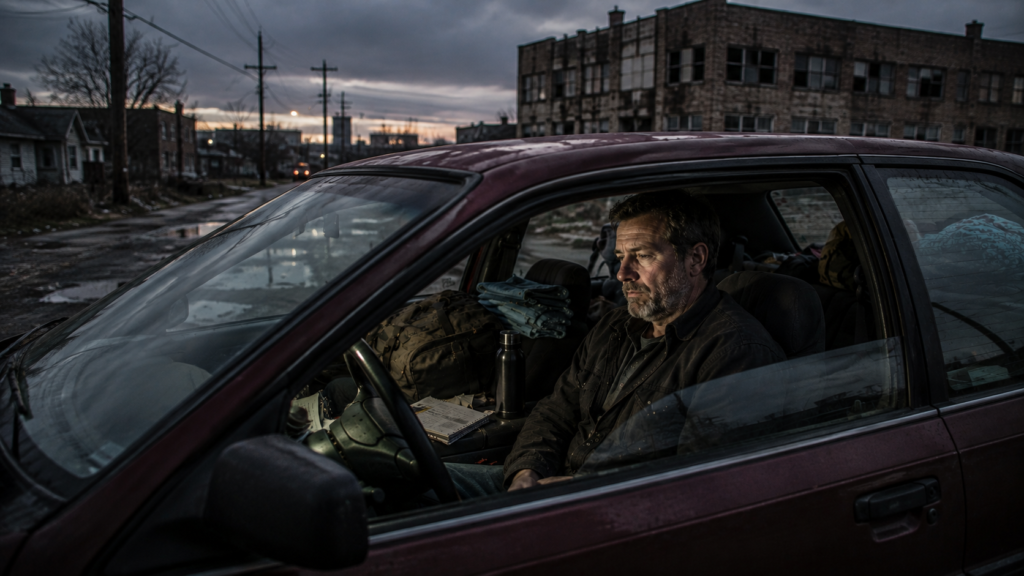
This article reflects my personal experiences, observations, and opinions about homelessness, housing affordability, vehicle dwelling, and the growing number of people struggling to find a stable place to live.
I want to talk about something that is personal for me.
I have been homeless twice.
When most people hear the word “homeless,” they picture tents.
They picture sidewalks.
They picture people sleeping under bridges.
But homelessness doesn’t always look like that.
Sometimes…
It’s someone sleeping in their car.
Sometimes…
It’s a family living in an RV.
Sometimes…
It’s someone parking in a different parking lot every night, hoping nobody knocks on their window.
And sometimes…
It’s a person with a full-time job who simply can’t afford rent anymore.
Today I want to talk about something I don’t think we discuss honestly enough.
The business of being homeless.
More People Are Losing Housing
According to the latest federal Point-in-Time count, 745,652 people were experiencing homelessness on a single night in January 2025.
That was a 3% decrease from 2024, when the federal count reached 771,480 people, the highest number recorded at that time.
The 2025 count also found 266,320 people experiencing unsheltered homelessness—people living in places not intended for human habitation.
HUD — 2025 Annual Homelessness Assessment Report
HUD USER — 2025 Point-In-Time Estimates
That’s an important distinction.
The number went down slightly from the previous year, but homelessness remains dramatically higher than it was a decade ago. HUD reports that overall homelessness increased 27% between 2013 and 2025, while unsheltered homelessness increased 36% and chronic homelessness increased 81% over that period.
HUD — 2025 Annual Homelessness Assessment Report
And remember…
That’s a one-night count.
It isn’t a count of every person who experienced a housing crisis during the year.
The federal Point-in-Time system is designed to estimate homelessness on a particular night, not capture every person who moves between friends’ homes, motels, vehicles, shelters, and other temporary arrangements.
That means there are forms of housing instability that are difficult to see in the official numbers.
The Invisible Homeless
One thing I’ve noticed is that there’s a kind of homelessness we rarely talk about.
People living in cars.
Vans.
SUVs.
Pickup trucks.
Campers.
Old RVs.
The federal government actually has a term for part of this problem: vehicular homelessness.
The U.S. Interagency Council on Homelessness explains that vehicular homelessness includes people residing in passenger vehicles because they cannot obtain or maintain safe, suitable housing. People living in cars are generally considered part of unsheltered homelessness.
But there is a major problem with the data.
There is no consistent national system for counting how many people experiencing homelessness are living in vehicles.
U.S. Interagency Council on Homelessness — How Communities Are Responding to Vehicular Homelessness
That means the person sleeping in a car can be much harder to see in the statistics than the person sleeping in a tent.
Some people call it vehicle dwelling.
Others call it stealth camping.
Some identify as van lifers.
Others are digital nomads.
Those aren’t all the same thing.
Some people choose that lifestyle.
Others never planned on it.
They simply ran out of options.
USICH specifically identifies people who have lost jobs, been evicted, cannot afford rent, or are seniors unable to afford housing among the groups who may end up living in vehicles.
USICH — How Communities Are Responding to Vehicular Homelessness
The Internet Sells a Dream
If you spend enough time online, living in a van can look incredible.
Beautiful sunsets.
National parks.
Tiny houses on wheels.
Freedom.
Adventure.
Working from anywhere.
And for some people…
That really is their experience.
But there is another side that doesn’t always make it onto YouTube.
Finding a legal place to park.
Finding a safe place to sleep.
Finding a bathroom.
Finding clean water.
Keeping cool during summer.
Keeping warm during winter.
Repairing a vehicle that’s also your home.
Living with the constant possibility that someone may knock on your window in the middle of the night.
For many people…
That’s not freedom.
That’s survival.
And the federal government recognizes that housing affordability is one of the major factors behind vehicle homelessness. USICH notes that inability to afford rent and displacement are major drivers of people ending up living in vehicles.
USICH — How Communities Are Responding to Vehicular Homelessness
Cities Are Pushing Back
At the same time, many cities are making it increasingly difficult to live in vehicles or homeless encampments.
In 2024, the U.S. Supreme Court’s decision in Grants Pass v. Johnson ruled that enforcement of generally applicable laws regulating camping on public property does not constitute cruel and unusual punishment under the Eighth Amendment.
U.S. Supreme Court — City of Grants Pass v. Johnson
That decision gave cities greater legal authority to enforce public camping restrictions.
The issue is complicated because communities are trying to balance public safety, public spaces, neighborhood concerns, and the rights and needs of people who have nowhere else to go.
California has taken an increasingly aggressive approach to the problem.
Governor Gavin Newsom has made homelessness one of his administration’s major priorities, including efforts to clear encampments while connecting people with shelter, housing, health care, and other services.
In July 2024, following the Grants Pass decision, Newsom issued an executive order directing state agencies to address homeless encampments and encouraging local governments to take similar action. The state said its approach should prioritize offers of shelter and services when resolving encampments.
Governor of California — Newsom orders state agencies to address encampments
California has also committed substantial amounts of money toward homelessness.
Newsom had already been pushing California to address homelessness more aggressively. In a 2024 State of the State address, he said California had cleared more than 9,300 dangerous encampments and had moved people into shelter or housing through programs including Homekey and Project Roomkey.
Los Angeles has been one of the major areas involved in those efforts.
Los Angeles County reported in 2024 that state funding from Newsom’s Encampment Resolution Fund helped move 1,975 people into interim housing and 990 people into permanent housing during the first year of one Skid Row program. The county also reported that approximately 8,000 people experiencing unsheltered homelessness received outreach or other services through the program.
Newsom’s administration has also worked with Los Angeles on encampment removals and connecting people with shelter and supportive services.
No matter where you stand politically…
One thing is clear.
Removing a tent doesn’t automatically solve homelessness.
Moving someone from one location doesn’t necessarily give them a permanent place to live.
If there isn’t somewhere affordable for them to go…
The problem can simply move somewhere else.
Los Angeles has also been one of the major focuses of these efforts.
Mayor Karen Bass launched Inside Safe, a program designed to move people from encampments into temporary and permanent housing while providing supportive services.
Newsom’s administration has also deployed its SAFE Task Force in Los Angeles to work with the city and county on encampments located on state property.
And there is evidence that some of these efforts have coincided with improvements.
California reported that its unsheltered homeless population fell by approximately 9% in 2025, which the Newsom administration described as the state’s largest decrease in more than 15 years. Los Angeles also reported a significant decline in unsheltered homelessness.
Governor of California — California sees drop in unsheltered homelessness
That doesn’t mean California has solved homelessness.
It hasn’t.
It means some of the newer efforts appear to be producing measurable results, particularly in reducing the number of people living unsheltered.
But there’s an important distinction here.
Removing a tent doesn’t automatically solve homelessness.
If someone is removed from an encampment and placed into permanent housing, treatment, or another stable situation, that’s one thing.
But if someone is simply moved from one location to another…
The problem hasn’t really been solved.
The person is still homeless.
That’s why I think the conversation needs to go beyond whether an encampment was removed.
We need to ask what happened to the people who were living there.
Did they receive shelter?
Did they receive permanent housing?
Did they receive medical or mental-health services when they needed them?
Did they find employment?
And most importantly…
Where are they now?
California’s approach is worth watching because it combines several different strategies—encampment enforcement, housing, shelter, behavioral-health services, and significant public spending.
But even with recent improvements, the scale of the problem remains enormous.
No matter where you stand politically…
One thing is clear.
Removing a tent doesn’t automatically solve homelessness.
The ultimate goal has to be getting people somewhere safe and stable to live.
Otherwise, we’re just moving the problem around.
Hostile Architecture
Then there’s something called hostile architecture.
You may not know the name.
But you’ve probably seen it.
Benches with dividers.
Metal spikes.
Sloped seating.
Large rocks placed under overpasses.
Designs intended to discourage people from sitting or sleeping.
Cities including New York have used these kinds of designs in some public spaces over the years as part of broader efforts to discourage loitering or sleeping in those areas.
The term “hostile architecture” or “defensive architecture” has been used to describe designs that intentionally make public spaces less usable for certain activities, including sleeping.
Smithsonian Magazine — Londoners Are Fighting Back Against “Hostile Architecture”
Supporters argue they’re necessary for public safety and keeping shared spaces accessible.
Critics argue they push vulnerable people from one block to another without addressing why they’re there in the first place.
And that’s the larger question.
Where does the person go after you’ve removed the place where they were sleeping?
The Business of Survival
Here’s where I think the conversation gets uncomfortable.
Being homeless doesn’t mean you stop having expenses.
In some ways…
You can end up paying more simply because you don’t have a stable home.
You may have to pay for a gym membership just to have access to a shower.
You may have to pay for a laundromat.
You may have to pay for storage.
You may have to pay for parking.
You may have to pay for gas just to keep your vehicle warm or cool.
You may have to spend money simply to maintain a basic level of privacy and security.
After all of the things you need, they all require money.
And that means you need a job.
But getting a job can be difficult when you don’t have an address.
You can’t use the bridge or a parking lot as your home address for everything you need to do.
Your address is required on several forms and applications, including tax forms.
So now you’re caught in a cycle.
You need money to maintain a basic level of privacy, security, transportation, food, storage, and other necessities.
You need a job to get that money.
But getting a job can require an address.
And when you don’t have a stable place to live, even something as basic as providing an address can become another barrier standing between you and getting back on your feet.
And this is where the idea of homelessness as simply a person who doesn’t have a house starts to fall apart.
It’s not just about where you sleep.
It’s about whether you can maintain the basic infrastructure required to participate in society.
An address.
A phone.
Transportation.
Identification.
A place to receive mail.
A place to store your belongings.
A place where you can shower.
A place where you can safely sleep.
All of these things make it easier to work your way out of homelessness.
And without them…
Getting back into the system can become much harder.
Who Benefits?
Here’s the question I keep coming back to.
Who benefits?
People lose housing.
Someone profits.
Rent goes up.
Someone profits.
Storage units.
Extended-stay hotels.
Predatory lenders.
Payday loans.
Vehicle financing.
Towing companies.
Parking fines.
Late fees.
There are entire industries that make money from financial instability.
I am not saying that businesses are the only cause, government isn’t helping the situation either.
And I’m not saying every company providing these services is exploiting homeless people.
Some of these services are necessary.
If your car is your home, you still need somewhere to repair it.
If you’ve lost your housing, you may need a motel.
If you have nowhere to store your possessions, you may need storage.
The point is that financial instability creates expenses of its own.
Financial hardship has become an economy of its own.
It Could Happen to More People Than We Think
One unexpected medical bill.
One layoff.
One divorce.
One rent increase.
One vehicle repair.
For many Americans…
That’s all it takes.
Housing costs are one of the biggest pieces of the puzzle.
HUD’s research on homelessness has found that housing-market factors—including rental costs, crowding, and evictions—are among the factors most consistently associated with higher rates of homelessness at the community level.
HUD USER — Housing and Poverty Research
And when housing costs rise faster than people’s incomes…
The number of people living on the edge increases.
Some people have family members they can move in with.
Some have friends.
Some have savings.
Some have credit cards.
Some have none of those things.
And when the options run out…
The car can become the last option.
The RV can become the last option.
A motel can become the last option.
And eventually…
There may be no option left.
Homelessness Doesn’t Always Mean Unemployed
A person can have a job and still be homeless.
They can work forty hours a week and still not be able to afford an apartment.
They can have a vehicle and still be living in that vehicle.
They can show up to work every morning while spending every night wondering where they’re going to park.
The U.S. Interagency Council on Homelessness has stated that as many as 40%–60% of people experiencing homelessness have a job, while emphasizing that employment does not guarantee housing when housing costs are unaffordable.
That doesn’t mean every homeless person works.
It means the stereotype that homelessness automatically means unemployment is wrong.
And that’s becoming harder to ignore as housing costs continue to rise.
The Business of Being Homeless
That’s why I think the phrase “the business of being homeless” matters.
There doesn’t have to be some giant conspiracy for an economy to develop around people’s hardship.
Businesses respond to demand.
If millions of people are struggling to afford housing…
There will be businesses willing to provide something they need.
Storage.
Transportation.
Temporary housing.
Credit.
Loans.
Parking.
Food.
Showers.
Phone service.
And sometimes those services are legitimate and necessary.
But when you’re poor…
Everything costs money.
And sometimes the people with the least money end up paying the most simply because they don’t have the stability that other people take for granted.
Buying Land Doesn’t Mean You Can Live There
For someone who is struggling with housing costs, buying a cheap piece of land can sound like the obvious solution.
If you can’t afford a house…
Maybe you can buy some land and put an RV or tiny home on it.
At least then you own the property.
Unfortunately, it isn’t always that simple.
Owning land doesn’t automatically mean you can live on it however you want.
County zoning and building codes can determine what you’re allowed to put on the property.
Some counties may not allow an RV to be used as a permanent residence.
Some may have restrictions on tiny homes on wheels.
Some may require a permanent foundation.
Some may require permits before a structure can be occupied.
Some areas don’t allow mobile homes on certain properties.
And even if the county allows the type of home you want…
You still have to deal with the infrastructure.
You may need electricity.
You may need a well.
You may need sewer service.
Or you may need to install a septic system.
You may need a driveway.
A road.
And you would also need to make sure that the property isn’t landlocked and that the roads available to reach it aren’t private roads that you don’t have legal permission to use.
You need to verify that you have legal access to the property.
That may mean checking whether there is a recorded easement, whether the road is public or private, who maintains it, and whether you have the legal right to travel across it.
A cheap piece of land can become much more expensive if you have to build the infrastructure necessary to make it usable.
And that’s before you even start talking about the cost of the RV, tiny home, mobile home, utilities, permits, site preparation, septic system, driveway, or other improvements.
So even the idea of escaping the housing market by simply buying cheap land comes with its own set of barriers.
You can own the land…
And still not have a legal place to live.
The Difference Between Choice and Survival
I don’t want to dismiss people who choose van life.
There are people who genuinely enjoy it.
They want to travel.
They want fewer possessions.
They want to live differently.
There’s nothing wrong with that.
But we shouldn’t confuse voluntary minimalism with involuntary homelessness.
Someone who chooses to live in a van because they want to travel is in a very different situation from someone living in a van because they lost their home.
From the outside, those two people can look almost identical.
The difference is whether they have somewhere else they can go.
The federal government’s own report on vehicular homelessness makes this distinction, specifically focusing on people who live in vehicles out of necessity because they cannot obtain or maintain safe, suitable housing rather than people who voluntarily live a nomadic lifestyle.
USICH — How Communities Are Responding to Vehicular Homelessness
The Hidden Cost of Losing Housing
There’s another part of homelessness that doesn’t get talked about enough.
Once you lose stable housing, getting back into stable housing can become harder.
You may lose access to a permanent mailing address.
You may have trouble keeping important documents safe.
You may struggle to maintain employment because transportation becomes more complicated.
You may have difficulty storing your possessions.
You may have to move constantly.
You may have to choose between paying for food, gas, repairs, insurance, or somewhere to sleep.
And if your vehicle breaks down…
You haven’t just lost transportation.
You may have lost your home.
That’s an entirely different level of financial risk.
Closing
I don’t think anyone grows up hoping they’ll live in a car.
I don’t think anyone dreams about wondering where they’ll park tonight.
And I don’t think homelessness is something that only happens to “other people.”
For some…
Van life is an adventure.
For others…
It’s the last step before having nowhere left to go.
Those are two very different stories.
I’ve experienced homelessness myself.
That’s why I have a hard time looking at this issue as something that only happens to people who made bad decisions.
Sometimes people make mistakes.
Sometimes addiction is involved.
Sometimes mental illness is involved.
Sometimes people lose control of their lives.
But sometimes…
People simply can’t afford housing anymore.
A person can work hard and still lose their home.
A person can do everything they were told they were supposed to do and still end up struggling.
Maybe before we argue about where people should sleep…
We should spend more time asking why so many people can’t afford a place to live in the first place.
Because until we answer that question…
**We’re treating the symptoms.
Not the cause.**
And removing a tent doesn’t automatically solve homelessness.
It may move the person.
It may move the problem.
But it doesn’t necessarily solve the reason they ended up there.
(Look directly into camera.)
What do you think is driving the housing and homelessness crisis?
Housing costs?
Mental health?
Addiction?
The economy?
A lack of affordable housing?
Something else?
Leave a comment below.
I’d genuinely like to hear your perspective.
About The Exploited Worker 138
The Exploited Worker 138 is an independent publication exploring work, layoffs, unemployment, artificial intelligence, automation, the economy, technology, housing, and what it means to rebuild in a changing world.
The goal isn’t to pretend we have all the answers.
It’s to have the conversations that often don’t happen until after the job is gone.
Starting Over in a Broken System.