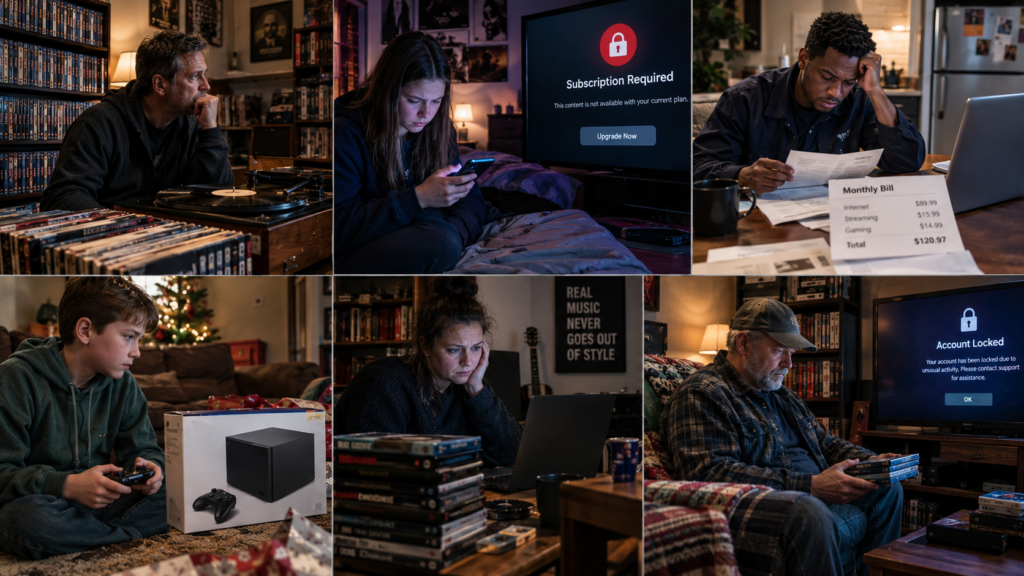
This article reflects my personal experiences, observations, and opinions about ownership, subscriptions, digital media, technology, and the changing relationship between consumers and the things they buy.
I want to talk about something that doesn’t get nearly enough attention.
Ownership.
Or maybe I should say…
The slow disappearance of it.
Because I’ve noticed something over the last twenty-plus years.
It started with Netflix for me, although cable television came before it.
I remember going to buy CDs.
Yeah, kids—we could go buy music.
When I would buy CDs, I would sometimes get coupons for Netflix. Back then, Netflix was a completely different service. You would mail movies back and forth.
There was no streaming.
Anyways, back to the topic at hand.
We don’t actually buy as much as we used to.
We subscribe.
We rent.
We stream.
We lease.
We license.
And those aren’t the same thing.
There was a time when buying something meant it was yours.
You bought a movie.
You owned it.
You bought a CD.
It was yours.
You bought a video game.
You could play it twenty years later.
Lend it to a friend.
Sell it.
Put it on a shelf.
Today…
That’s becoming less common.
More and more companies aren’t selling ownership.
They’re selling access.
And access can be taken away.
We’ve already seen movies disappear from streaming services.
Digital games removed from online stores.
If you buy some video games, they now are just a code in a box.
A box with a disc that doesn’t actually contain the game.
It’s basically a glorified key to download the game.
So if you don’t have an internet connection, or they decide to delist it, the item you physically bought can become useless.
Books can be edited after purchase.
Music can vanish because licensing agreements expire.
Software can stop working when support ends.
You paid.
But you didn’t necessarily own it.
And I think that’s a much bigger shift than most people realize.
Why Corporations Like It
From a business perspective…
It makes perfect sense.
If customers own something…
They buy it once.
Which means it can be resold or loaned and the company loses out on sales.
If customers subscribe…
They keep paying.
Every month.
Every year.
Potentially forever.
Predictable revenue.
Predictable investors.
Predictable profits.
That’s why subscriptions have spread into almost every part of our lives.
Movies.
Music.
Video games.
Office software.
Television.
Cloud storage.
Even heated seats in some cars.
It’s no longer just about selling products.
It’s about selling continuous access.
The Problem
Now…
I’m not saying subscriptions are always bad.
Magazines and newspapers were a great example of that.
Sometimes they’re convenient.
Sometimes they save money.
Sometimes they give people access to things they couldn’t otherwise afford.
I subscribe to services myself.
It actually helps me get things quicker.
That’s really about it, though.
But here’s where I think we need to be careful.
When everything becomes a subscription…
Nobody actually owns very much anymore.
And if you stop paying…
Your movies disappear.
Your music disappears.
Your software stops working.
Your cloud storage may become inaccessible.
Your pictures.
Your memories.
Can disappear.
Sometimes even your games disappear.
That’s a very different relationship than ownership.
Video Games
Video games might be the best example.
More games require online accounts.
Constant internet connections.
Digital storefronts.
Subscriptions.
Some games become completely unplayable once the servers shut down.
Not because your computer broke.
Not because your console failed.
Because someone in a boardroom decided it was no longer profitable to keep the servers running.
Sometimes it’s because you violated a terms of service, your account gets hacked, sometimes PlayStation Network goes down or Xbox goes down.
We’ve already seen this happen. In February 2025, the PlayStation Network experienced a global outage that lasted about 18 hours and prevented users from signing in, playing online, and accessing the PlayStation Store. Reuters — Sony to offer PlayStation Plus users five-day extension after global outage
Xbox has experienced similar problems. During a major Xbox Live outage in July 2024, users were unable to sign in to their Xbox profiles, and features requiring sign-in—including many games, apps, and social features—were unavailable. PCWorld — Xbox Live games are down due to sign-in problems
And just like that…
Something people paid for disappears.
Then there’s PlayStation switching to all digital, no physical. Sony says physical game disc production for new PlayStation games will end in January 2028, with new games being made available in digital formats only. Sony says this is because the general preference for digital media significantly outpaces physical discs. PlayStation Blog — Physical disc production ending in January 2028
Here’s the thing with that.
If you only offer something digital or offer only a code in box for something then of course it’s a digital only sale.
There’s no other option!
And we’re already seeing an example of how companies classify these kinds of products. Capcom was asked whether Nintendo Switch 2 Game-Key Cards were recorded as physical or digital units, and Capcom’s answer was:
“They are recorded as digital sales.”
Capcom — Question and Answer Summary
These Game-Key Cards are sold in physical boxes, but the card contains an activation key rather than the actual game data, meaning the game still has to be downloaded. Capcom considers those purchases digital sales. Nintendo Life — Capcom Is Recording Switch 2 Game-Key Card Purchases As “Digital Sales”
Movies and Music
Movies and television have changed too.
Instead of buying DVDs…
We stream.
Instead of owning music…
We subscribe.
It’s convenient.
Until something leaves the catalog.
Then you realize…
You never really owned it in the first place.
You also start to realize that you may be paying more than you did for cable, depending on how many streaming services you have.
You’re paying more than you would have for CDs, but you’re still getting bombarded with ads unless you want to pay extra.
When streaming first became popular, one of the big selling points was that you could pay for streaming and not have commercials like you did with cable.
Now you pay for streaming…
And then you pay more if you don’t want the ads.
You used to be able to have multiple devices on your account.
Now some services limit you to one or maybe two devices unless you pay more.
Now listening to music or watching movies isn’t really that different from how it was in the past, except the cost is higher.
Because you can’t find everything in one place.
You might need three, four, five, or even more different services just to watch the shows and movies you want.
The same thing is happening with music.
And that’s where the convenience starts to disappear.
You’re paying multiple companies every month just to have access to things that you used to be able to buy once and keep.
Why This Matters
Some people might ask…
“So what?”
Technology changes.
That’s normal.
And they’re right.
Technology does change.
But I think this is bigger than technology.
It’s about control.
It’s about taking every dollar from you continuously, because you want to watch your favorite shows and listen to your favorite songs.
Who decides what you can access?
Who decides what disappears?
Who decides what you continue paying for?
Increasingly…
It isn’t you.
It’s a corporation.
The Bigger Picture
When I step back…
I see a pattern.
Subscriptions.
Streaming.
Cloud computing.
AI services.
Digital licenses.
More of our lives depend on paying companies every month.
That’s great for predictable corporate revenue.
I’m not convinced it’s always great for consumers.
Especially when prices continue rising.
And competition keeps shrinking.
The Quiet Trade-Off
The trade-off is easy to overlook because convenience feels like a good deal.
You don’t have to store shelves full of DVDs.
You don’t have to carry around a collection of CDs.
You don’t have to install software from physical media.
You can access enormous libraries of entertainment, information, and software from almost anywhere.
That’s genuinely useful.
But convenience can also mean giving up control.
When you own the physical product, the company generally has less control over what you do with it after the sale.
You can keep it.
You can lend it.
You can sell it.
You can put it in a closet for twenty years and forget about it.
With a subscription or digital license, the relationship is different.
Sony just admitted in court that you don’t own anything you buy. In a current lawsuit over the PlayStation Store, Sony is arguing that consumers receive a license to use digital games rather than actually owning them. Tom’s Hardware — Sony argues ‘reasonable consumers would not be misled’ into believing they own digital games
Valve, who have the PC gaming space Steam which is has the largest share of players on the planet had to admit that you are purchasing a license. Steam’s own Subscriber Agreement states that the content and services are “licensed, not sold.” Steam Subscriber Agreement The Verge — Steam now says the ‘game’ you’re buying is really just a license
You’re depending on the company to keep providing access.
That means the consumer isn’t simply buying a product anymore.
The consumer is maintaining a relationship with a service provider.
And that relationship can change.
Prices can increase.
Terms can change.
Features can disappear.
Products can be discontinued.
Servers can be shut down.
Licenses can expire.
Accounts can be hacked.
Companies can ban your account because they say say you violate their “Terms of Service” or EULA.
They can take you money and make a small change to take the licenses to your purchases because of a sentence written in legal jargon in the fine print. Sony’s current terms state that digital software is licensed rather than sold, and Sony’s terms also allow access to services to be suspended or terminated under certain circumstances. PlayStation Terms of Service PlayStation Software EULA
Steam also has provisions allowing Valve to terminate access under the terms of its Subscriber Agreement, and Valve’s agreement makes clear that the content is licensed rather than sold. Steam Subscriber Agreement
What Happens When Everything Becomes Digital?
This is where I think the conversation gets even more important.
Digital technology has given us incredible convenience.
But it has also changed what it means to possess something.
If I have a physical book sitting on my shelf, I can read it without asking a company for permission.
If I own a CD, I don’t need a subscription service to listen to the music.
If I own a physical movie, I don’t have to worry about whether the streaming service still has the licensing rights.
If I own a physical game that actually contains the game, I can potentially play it decades later.
That physical object becomes something I control.
Companies are trying to change that too.
Farmers have been dealing with this problem for years. Modern tractors and farm equipment have become increasingly dependent on proprietary software, and farmers haven’t always had access to the tools needed to repair the equipment they bought.
The Federal Trade Commission sued John Deere, alleging that Deere restricted farmers and independent repair providers from accessing the software tools necessary to perform certain repairs, forcing farmers to rely on authorized dealers. FTC — FTC, States Sue Deere & Company to Protect Farmers from Unfair Corporate Tactics, High Repair Costs
In July 2026, the FTC and five states reached a settlement with Deere requiring the company, for the next 10 years, to provide farmers and independent repair providers with repair resources, including applicable software capabilities, that it had previously provided to authorized dealers. FTC — FTC, States Secure Settlement with Deere & Company, Advancing Farmers’ Right to Repair
Think about what that means.
You can buy a tractor.
You can physically possess the tractor.
You can park it on your property.
You can say, “This is my tractor.”
But if the manufacturer controls the software required to diagnose or repair it, how much control do you really have over the machine?
And this isn’t just happening with tractors.
We’re seeing governments starting to recognize the problem with products that become difficult or impossible for their owners to repair.
The European Union is taking a different approach with batteries.
Under the EU’s Batteries Regulation, portable batteries in products sold in the EU must generally be removable and replaceable by consumers. The rules are intended to help extend product lifetimes by allowing battery replacements and to make recycling easier. European Commission — Commission adds exemptions to portable battery removal rules
The European Commission has said that starting in 2027, consumers will be able to remove and replace portable batteries in their electronic products during the life cycle of the product, helping extend the life of those products before they are discarded. European Commission — New law on more sustainable, circular and safe batteries enters into force
That’s an interesting idea.
Because a battery is one of the components most likely to wear out.
If the battery dies but the rest of the product still works, why should the entire product become disposable?
The EU is essentially saying that, in many cases, the consumer should be able to replace that part and keep using the product.
That’s what ownership used to mean.
You bought something.
You maintained it.
You repaired it.
You replaced worn-out parts.
You kept it working.
The more manufacturers control the software, parts, diagnostic tools, batteries, and repair process, the more complicated that relationship becomes.
You may physically own the object.
But someone else can still control whether you’re able to repair it.
And that’s another way ownership can slowly disappear without the product itself ever disappearing.
Digital products don’t always work that way.
Sometimes what looks like ownership is actually a license.
Sometimes the physical object is simply a gateway to a digital service.
And sometimes the thing you bought depends on infrastructure controlled by someone else.
That’s a fundamental change.
We Giving Up Ownership Without Realizing It?
I’m not saying we should go back to the 1990s.
Technology moves forward.
It will.
And it should.
But I do think we need to ask a simple question.
Are we giving up ownership without really thinking about what we’re losing?
Convenience is valuable.
But ownership has value too.
Because when you own something…
It doesn’t disappear because a license expires.
It doesn’t disappear because a company changes strategy.
It doesn’t disappear because the monthly payment stopped.
Maybe that’s a conversation worth having before ownership becomes something we only remember.
What Do You Think?
Do you still buy physical media?
Or have subscriptions completely replaced ownership for you?
Do you prefer owning a physical copy of something, or is the convenience of streaming and digital access worth giving up ownership?
I’d genuinely like to hear your perspective.
About The Exploited Worker 138
The Exploited Worker 138 is an independent publication exploring work, layoffs, unemployment, artificial intelligence, automation, the economy, technology, and what it means to rebuild in a changing world.
The goal isn’t to pretend we have all the answers.
It’s to have the conversations that often don’t happen until after the job is gone.
Starting Over in a Broken System.