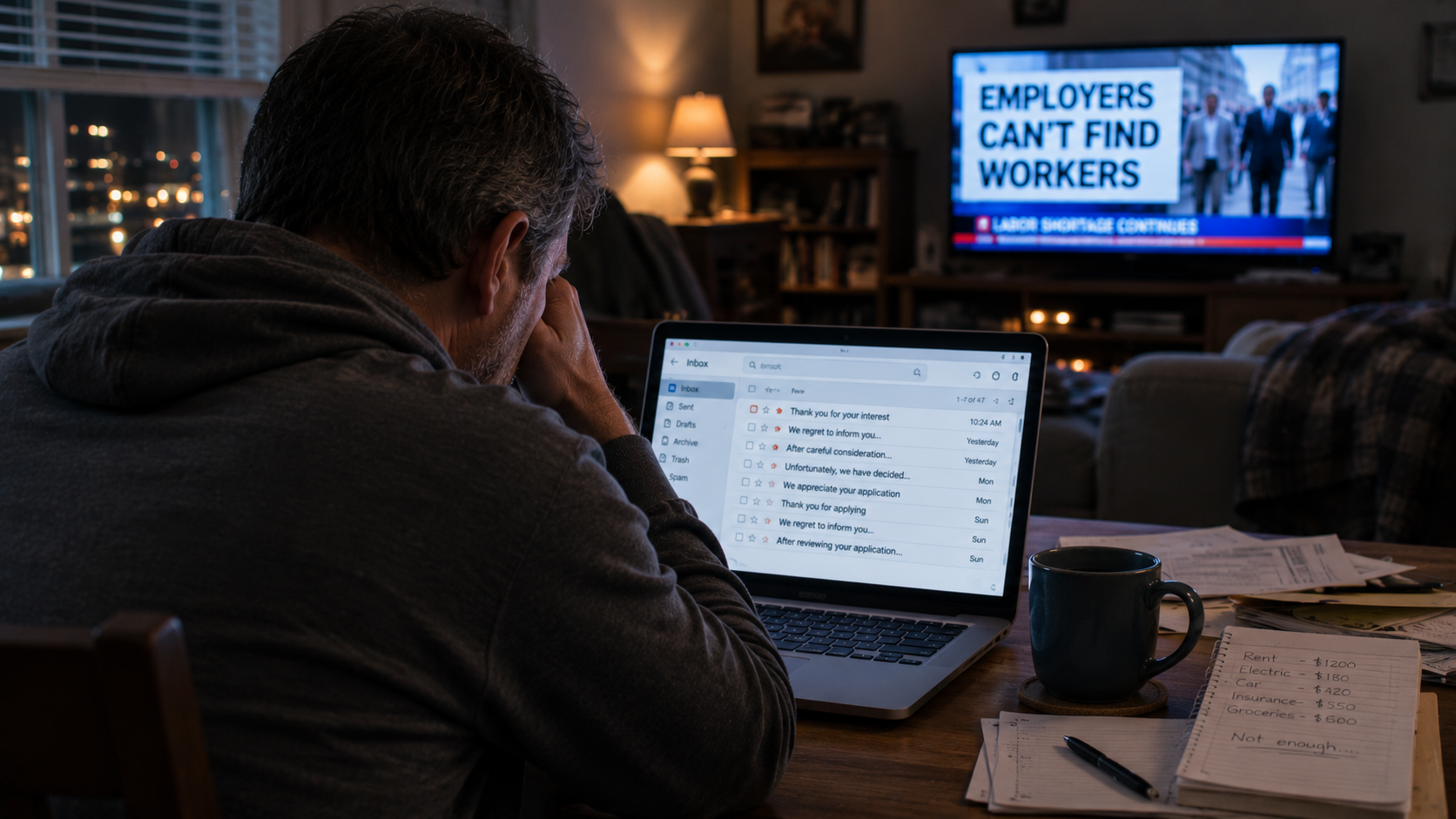
In this article: Everywhere you look, there are “Now Hiring” signs, online job postings, and headlines about labor shortages. Yet countless qualified people are sending out application after application without receiving interviews—or even a response. Why does it feel like jobs are everywhere, but nobody is actually hiring?
If you’ve spent any time looking for work recently, you’ve probably asked yourself the same question I have.
If companies are hiring everywhere…
Why does it feel like nobody’s actually hiring?
Everywhere I look, I see job postings. I see “Now Hiring” signs in store windows. I read headlines about labor shortages and hear people repeat the phrase, “Nobody wants to work.”
At the very same time, I know people who have submitted hundreds of applications without getting a single interview.
Something doesn’t add up.
The Experience Many Job Seekers Know Too Well
The process has become painfully familiar.
You find a position that matches your experience.
You update your résumé.
You customize your cover letter.
You answer pages of online questions—many of which ask for information that’s already on your résumé.
You click Submit.
Then…
Nothing.
No phone call.
No interview.
Sometimes not even a rejection email.
And when a rejection finally arrives, it often feels like an automated template that could have been sent to anyone.
After enough silence, it’s hard not to take it personally.

When Silence Becomes Self-Doubt
One of the hardest parts of job searching isn’t always rejection.
It’s silence.
At least a rejection tells you that someone—or something—processed your application.
Silence leaves you wondering.
Was anyone actually hiring?
Did anyone read my résumé?
Was I rejected automatically?
Or did my application simply disappear?
Eventually, those questions start turning inward.
Maybe my experience isn’t relevant anymore.
Maybe I’m too old.
Maybe I don’t have the right skills.
Maybe I’m the problem.
I think many workers have had those thoughts.
I know I have.
The Hiring Process Has Changed
When I first entered the workforce, applying for a job looked very different.
You walked into a business.
You talked to someone face-to-face.
You shook hands.
You handed over an application.
There was a human being involved somewhere in the process.
Today, it often feels like you’re applying to software.
Résumés are scanned.
Applications are filtered.
Candidates are ranked.
Sometimes applications are rejected before a hiring manager ever sees them.
Technology has undoubtedly made hiring more efficient in some ways.
But from the applicant’s perspective, it can also make the process feel distant and impersonal.
Workers aren’t just competing with other applicants anymore.
Sometimes it feels like we’re competing with algorithms.
Experience Doesn’t Always Speak for Itself
Many experienced workers spent decades developing valuable skills.
Learning how to solve problems.
Working with customers.
Managing projects.
Training coworkers.
Adapting to change.
Yet today’s hiring process often seems focused on keywords and automated filters before experience is ever considered.
That’s frustrating.
Especially for people who have spent years building careers.
It can feel as though experience matters less than knowing how to optimize a résumé for software.

Are All Posted Jobs Really Open?
Another question I’ve been thinking about is whether every posted job is actually being filled.
There are plenty of legitimate reasons a job posting may stay online without resulting in a hire.
Companies may pause hiring because of budget changes.
Internal candidates may already be under consideration.
Hiring freezes can happen unexpectedly.
Some organizations collect applications before positions officially open.
From the applicant’s perspective, though, none of that is visible.
All they see is another application disappearing into the void.
That uncertainty makes an already difficult process even harder.
The Emotional Cost of Modern Job Searching
The financial impact of unemployment gets most of the attention.
The emotional impact often doesn’t.
Sending dozens—or even hundreds—of applications without hearing back takes a toll.
Confidence begins to fade.
You start questioning your value.
You wonder whether your skills still matter.
You wonder whether anyone is actually reading what you’ve worked so hard to prepare.
That’s especially difficult for workers who have spent years building careers only to discover that the hiring process has changed completely.

Why I Started Talking About This
I’ve been working since I was a teenager.
Over the years, I’ve filled out countless applications, interviewed for jobs, changed careers, and adapted to new industries.
I’ve watched the hiring process evolve dramatically.
One thing stands out more than anything else:
We’re expected to invest more time than ever applying for jobs, yet many workers feel less seen than ever before.
That disconnect is part of why I started The Exploited Worker 138.
Not because I have all the answers.
I don’t.
But because I believe honest conversations about work, unemployment, hiring, technology, AI, and economic uncertainty matter.
Many people are experiencing these frustrations.
Far too many believe they’re experiencing them alone.
Final Thoughts
I don’t believe workers suddenly became lazy.
I don’t believe that “nobody wants to work.”
I think many people are working incredibly hard just to be noticed.
They’re updating résumés.
Learning new skills.
Applying consistently.
Adapting to a rapidly changing job market.
The effort is there.
For many people, the opportunities simply aren’t matching that effort.
Maybe that’s why so many workers keep asking the same question.
If jobs are everywhere…
Why does it feel like nobody’s hiring?

What Do You Think?
Everything in this article reflects my own experiences, observations, and opinions. They’re not the only perspective, and I don’t expect everyone to agree.
I’d genuinely like to hear yours.
If you’re currently looking for work, how many applications have you submitted?
How many interviews have you actually received?
Share your experience in the comments. Honest conversations are how we learn from one another.
About The Exploited Worker 138
The Exploited Worker 138 is an independent publication exploring work, layoffs, unemployment, artificial intelligence, the economy, and what it means to rebuild in a changing world. Through personal stories, research, and honest discussion, the goal is to create a place where workers can learn from one another and have conversations that often go unheard.